
Almost every dining table sold in Kolkata is chosen the wrong way round. People walk into a showroom, fall for a top, ask how many it seats, and only measure the room after it has been delivered. By then the chairs will not pull out on the kitchen side, or the table has swallowed the only walking route between the sofa and the balcony.
Sizing a dining table is not complicated, but the guides that rank for it are written for houses with a dedicated dining room, a doorway wide enough to carry a six-foot top through, and no ceiling fan overhead. That is not the Kolkata flat most of our customers live in. This is the version of the guide that accounts for the building you actually live in.
Start with the room, not the table
Measure the space where the table will stand and write down two numbers: length and width, wall to wall, in feet or centimetres. Then mark on that sketch every door swing, the kitchen entrance, the balcony route and any wall the sofa has to sit against.
The table itself is the smallest part of the calculation. What decides whether a dining set works is the empty space around it, and that empty space is fixed by the room before you have chosen anything.
The two numbers that decide everything
Per seat along the edge. Each person needs roughly 60 cm (2 ft) of table edge to eat without knocking elbows. Sixty-five to seventy is comfortable. Anything under 55 and two adults are sharing a place setting.
Clearance behind the chair. This is the number people skip, and it is the one that ruins rooms. From the table edge to the wall or the next piece of furniture, you want 90 cm (3 ft) so a chair can be pushed back and someone can walk behind a seated person. Seventy-five centimetres (2.5 ft) still works if nobody needs to walk past — the chair pulls out, the person sits, and that is the end of the movement on that side. Sixty centimetres is a squeeze you will resent every evening.
Table height is the one dimension you rarely need to worry about: almost every dining table made in India stands at 75 to 76 cm (30 inches), and standard dining chairs are built to match.
Dining table sizes by seat count
These are the working dimensions of rectangular tables in the Indian market, with the room they need at a comfortable 90 cm clearance on all four sides.
| Seats | Typical table size | Room needed (90 cm clearance) | Tight but workable |
|---|---|---|---|
| 2 | 75 × 75 cm square | 2.55 × 2.55 m (8.4 × 8.4 ft) | Against a wall, two sides only |
| 4 | 120 × 75 cm | 3.0 × 2.55 m (9.8 × 8.4 ft) | 2.7 × 2.25 m (8.9 × 7.4 ft) |
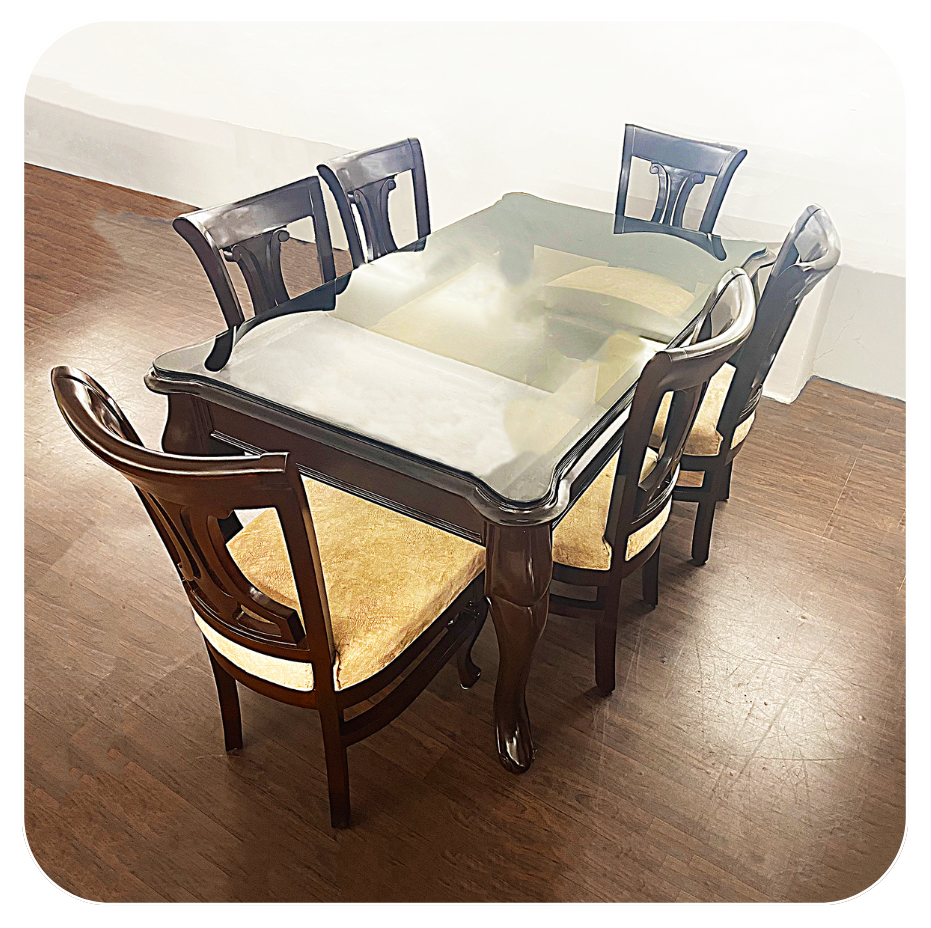
| 6 | 165 × 90 cm | 3.45 × 2.7 m (11.3 × 8.9 ft) | 3.15 × 2.4 m (10.3 × 7.9 ft) |
| 8 | 210 × 100 cm | 3.9 × 2.8 m (12.8 × 9.2 ft) | 3.6 × 2.5 m (11.8 × 8.2 ft) |
| 4 (round) | 100 cm diameter | 2.8 m square (9.2 ft) | 2.5 m square (8.2 ft) |
| 6 (round) | 135 cm diameter | 3.15 m square (10.3 ft) | 2.85 m square (9.4 ft) |
Read the last column carefully. It assumes at least one long side is against a wall or a run of storage, so nobody walks behind those chairs. That single concession is what lets a genuine six-seater into a room a national buying guide would tell you is too small.
Round, rectangular or square — which suits a Kolkata flat
Rectangular is the most space-efficient shape per seat and the only sensible choice when the table has to sit against a wall or in a passage between the living room and the kitchen. It is also the shape that scales — you can add a chair at each end when guests arrive.
Round is better than its reputation in a small flat. There are no corners to walk into, so it tolerates a tighter clearance on the circulation side, and six people around a circle can all hear each other. The catch is that a round table cannot go against a wall without wasting half of itself, so it needs a genuine open square of floor. Round tables above about 150 cm across also put the centre out of everyone’s reach, which is a real problem for the way most Kolkata families eat, with serving dishes on the table.
Square works beautifully for four and awkwardly for anything else. In a compact flat a 90 cm square table pushed into a corner, with two chairs and a bench, seats four and gives back a metre of floor.
When there is no dining room at all
Most flats in Kolkata do not have a separate dining room. The table lives at one end of the living room, or in the throat between the living room and the kitchen. Three things follow from that.
First, the dining table and the sofa are competing for the same floor. Size them together, not separately — the same discipline we apply when sizing an L-shape sofa for a living room. If the sofa is already at its limit, the honest answer may be a four-seater dining table with a bench that tucks fully under it.
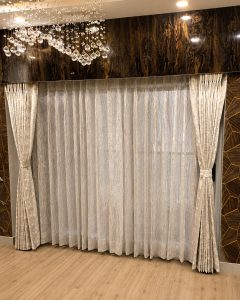
Second, the table is now furniture you look at all day, not just at mealtimes. It has to agree with the sofa, the curtains and the flooring, which is the whole argument behind furnishing a home as one scheme rather than room by room. A heavy carved teak set that would look magnificent in a separate dining room can overwhelm a living room it shares with a low modern sofa. If you are choosing the seating at the same time, our complete sofa buying guide covers the other half of that room.
Third, the ceiling fan. A pendant light over the dining table is the classic styling move, and in a Kolkata living room it usually collides with the fan — either the fan sits off-centre to the table, or the pendant hangs in the blade sweep. Decide which one wins before the electrician comes, not after. Where the fan cannot move, wall-washed light on the dining wall does the job without anything hanging.
The measurement almost everyone forgets
A solid wood dining top does not fold. Before you commit to a 180 cm table, measure the route it has to travel: the lift car and its door, the turn on the landing, the width of the staircase between the handrail and the wall, and your own flat door.
This matters more in Kolkata than in most Indian cities because so much of the housing stock is older. Lifts in buildings from the 1970s and 1980s around Central and North Kolkata are frequently too small to take a six-foot top upright, and the staircases turn tightly at every half landing. A marble or stone top adds weight to the same problem — it needs two people and a straight run.
The fixes are ordinary once you know the constraint: a table whose top detaches from the base, a top ordered a hand’s width narrower, or a knock-down design assembled in the room. All of them have to be decided before the order, which is why we ask about the lift at the enquiry stage rather than on delivery day.
Extendable tables and benches — the honest trade-offs
Extendable tables are the obvious answer for a family of four that hosts eight twice a year, and they genuinely work. Two cautions. The extended table still needs somewhere to extend into, so measure the room at full length, not folded — an extendable table in a room that cannot take it is simply a smaller table with a mechanism you never use. And the mechanism is the part that fails: butterfly and draw-leaf systems in solid wood take daily use far better than a hinged flap running on a light metal slide.
Benches buy back floor because they push fully under the table, and they seat three children where two chairs would seat two. They are worse for long meals with older family members, who need a back and an armrest. The arrangement that works in most compact flats is a bench on the wall side and proper chairs on the open side.
Whatever the shape, the material question sits underneath all of it — genuine solid wood, engineered board, veneer, and how each behaves through a Kolkata monsoon. We covered that separately in our guide to solid wood dining and bedroom furniture, and it is worth reading before you compare two tables on price alone. For heirloom-grade pieces, our note on why architects and designers specify Avikar explains what changes at that level.
Frequently Asked Questions
What size dining table fits a 10 x 12 ft room?
A six-seater at about 165 × 90 cm fits a 10 × 12 ft room comfortably, leaving roughly 90 cm of clearance on the long sides and a little under that at the ends. If the room also has to carry a sideboard or a walking route to a balcony, drop to a 150 cm table or a 135 cm round one.
What is the standard size of a 6-seater dining table in India?
Between 150 and 180 cm long and 90 cm wide, at a height of 75 to 76 cm. The 165 cm length is the one that behaves best in Indian homes — 150 cm seats six only if nobody is broad-shouldered, and 180 cm starts to demand a room most flats do not have.
How much space do you need around a dining table?
Ninety centimetres from the table edge to the nearest wall or piece of furniture is the comfortable figure, and it is what lets someone walk behind a seated person. Seventy-five centimetres is enough to pull a chair out and sit down where nobody needs to pass. Below 60 cm the chairs cannot clear the table properly.
Is a round or rectangular dining table better for a small flat?
Rectangular, if the table has to sit against a wall or in a passage, because it uses the space along one edge efficiently. Round, if you have a genuine open square of floor — there are no corners to catch a hip on, and conversation works better. A round table cannot be pushed against a wall without losing half its seats.
Can a dining table go in the living room?
Yes, and in most Kolkata flats it has to. Size the sofa and the table as one problem rather than two, keep a clear walking route between them, and choose a table that visually belongs with the sofa — it will be in view all day, not only at mealtimes.
Will a large dining table fit in my building’s lift?
Often not, in older Kolkata buildings. Measure the lift car and door, and the narrowest point of the staircase, before ordering anything above about 150 cm. Tops that detach from the base, or knock-down designs assembled in the room, solve it — but the choice has to be made at the order stage.
Are extendable dining tables worth it?
They are, if the room can actually take the extended length — measure at full extension, not folded. Choose a butterfly or draw-leaf mechanism in solid wood over a hinged flap on a light metal slide; the mechanism is what wears out first.
Bring your room measurements, not just a photo
Come to the showroom with the length and width of the space, and tell us where the kitchen door and the walking route are. We will tell you honestly what will seat six in it — and if the honest answer is a four-seater with a bench, we will say so rather than sell you a table you will spend five years walking around.
Avikar Furniture & Furnishings — furnishing Kolkata homes since 1971.
46 Central Avenue, Bowbazar, Kolkata, West Bengal 700012
Call or WhatsApp: 9830200750 / 8080095551