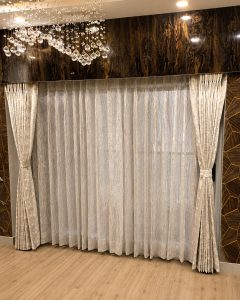
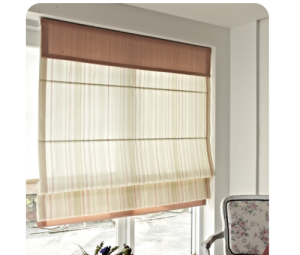
Most curtain disappointments in Kolkata homes are not fabric problems. They are measurement problems. A drop that stops two inches shy of the floor. A width that will not close over the grille. A rod fitted so low the curtain looks like it is hiding the window instead of framing it. Fabric can be chosen in an afternoon; a wrong measurement is stitched in permanently.
This is the method our measuring team has used across Kolkata since 1971. Follow it and you can shop with confidence — or simply understand exactly what we are doing when we come and measure for you, free of charge.
Measure the rod, not the window
This is the mistake almost everyone makes, and it is the expensive one. Curtain fabric is calculated from the rod or track, not from the window opening. The rod is deliberately wider and higher than the window so that when the curtains are drawn back they stack on the wall beside the glass rather than on top of it.
Hand a tailor your window dimensions and you will get curtains that only just cover the glass. Open them and half your daylight is still blocked by bunched fabric. Close them and the edges gape. Everything below follows from getting the rod right first.
What you need before you start
- A steel measuring tape. Cloth and plastic tapes stretch, and on a nine-foot drop a stretched tape can put you an inch out.
- A step ladder. Measuring a high rod from the floor with an outstretched arm is guesswork.
- A notepad, and a separate line for every single window. Do not assume two windows in the same room are identical. In older Kolkata buildings they very often are not — settlement, replastering and successive grille fittings leave differences of an inch or more.
Step 1: Decide where the rod goes
Height first. As a general rule the rod sits four to six inches above the window frame. If the wall above the window allows it, going higher — or mounting at ceiling level — draws the eye up and makes a standard flat window read as far taller than it is. It is the cheapest bit of drama available in a room.
If your flat has a false ceiling, settle this before you measure anything else. A rod fixed to the wall below the false ceiling and a track recessed into a pelmet above it produce drops that differ by several inches. Decide, then measure.
Width next. Extend the rod six to twelve inches past the frame on each side. Narrow windows benefit from the generous end of that range. This is the stacking space, and skipping it is why so many rooms feel dim even with the curtains open.
Step 2: Measure the width, then multiply it
Measure the rod from end to end, excluding the decorative finials — fabric does not travel over finials. That figure is your track width.
Now apply fullness. A curtain cut to the exact width of the rod hangs flat and looks like a bedsheet. Fullness is the multiplier that gives you folds:
- Sheers and light cottons: two to two and a half times the rod width. Light fabric needs volume to read as luxurious.
- Mid-weight cottons, linens and printed furnishing fabrics: two times.
- Heavy blackouts, velvets and lined drapes: one and a half to two times. The weight of the cloth creates its own body.
If you are having a pair rather than a single panel, divide the total finished width by two and add a few inches of overlap at the centre so the two panels meet properly instead of leaving a light gap down the middle.
Step 3: Measure the drop
Where you start depends on the heading, which we come to below. Where you finish is a design decision with three standard answers:
- Sill length: finishing about half an inch above the sill. Practical for kitchens and small bathrooms.
- Below sill: four to six inches under the sill. The safest choice when a radiator, desk, bed or deep ledge sits under the window.
- Floor length: finishing roughly half an inch clear of the floor for curtains you will open and close daily, or breaking gently on the floor for a softer, more formal look in a room where they mostly stay put.
On any window wider than about four feet, take the drop at the left, the centre and the right. Floors in older Kolkata properties are rarely dead level, and a curtain cut to a single measurement will visibly rise at one end.
The Kolkata complications the imported guides ignore
Search this question online and you will get excellent advice written for houses in Britain and Australia: bare plaster walls, a decorative pole, nothing in front of the glass. Our windows are not built that way, and four local realities change the numbers.
Grilles. Nearly every window here has one, and it projects from the wall. Your rod must be mounted on brackets deep enough that the fabric hangs clear of the grille rather than snagging on it every time it is drawn. Always measure your projection from the face of the wall, not from the glass.
Window air conditioners and exhaust fans. If a unit sits in the window, decide early whether you are curtaining around it, above it, or accepting a shorter drop on that window. It is far cheaper to decide now than after the fabric is cut.
Deep sills and ledges. A projecting sill pushes a sill-length curtain out at the bottom and it never hangs cleanly. On windows with a pronounced ledge, floor length almost always looks better.
Monsoon splash. A floor-length curtain at a window you keep open through the rains will wick water up the hem. In those specific rooms, a below-sill drop or a washable fabric is the sensible call.
Your stitching style changes where the drop begins
This is the step people skip. The same window measured for two different headings gives two different fabric orders. Avikar stitches pleats, pinch pleats, eyelets and tab tops, and each behaves differently:
| Heading | Start the drop from | Typical fullness | Best suited to |
|---|---|---|---|
| Eyelet | The top of the rod, then subtract about an inch — the fabric rises above the rod | 2x | Clean modern rooms; needs a rod, not a track |
| Pinch pleat | The bottom of the hook or ring | 2x to 2.5x | Formal living and dining rooms; the most tailored finish |
| Gathered or pencil pleat | The bottom of the ring, or the top of the track | 2x to 2.5x | Traditional interiors; works on tracks and pelmets |
| Tab top | The top of the rod, allowing for the tab length | 1.5x to 2x | Casual rooms, cottons and linens; not for daily heavy use |
A quick reference by room
| Room | Usual drop | Why |
|---|---|---|
| Living room | Floor length | Height and formality; the room most people see |
| Bedroom | Floor length, lined or blackout | Light control matters more than anywhere else |
| Kitchen | Sill or below sill | Keeps fabric away from the hob and off the counter |
| Bathroom | Sill length | Short, washable, quick to dry |
| Balcony or verandah door | Floor length, clearing the track by half an inch | Constant use; the hem must not drag |
Write it down like this
For each window, record: the room and a description of the window, the rod width excluding finials, the drop taken at three points, the mounting position, the heading style, whether it is a pair or a single panel, the fabric weight, and any obstruction such as a grille, an air conditioner or a deep ledge. Bring that sheet to the showroom and the conversation stops being guesswork.
Once you have your numbers, our curtain configurator lets you play with fabric and style combinations before you visit, and the rods, brackets and accessories that carry all of this are worth choosing at the same time rather than as an afterthought.
When to stop measuring and let us do it
If the windows are tall, arched, bay-shaped, behind a false ceiling, or you simply want the responsibility off your hands, our team will come to your home and measure every window free of charge. There is no obligation attached to it.
Worth knowing: our tailoring and installation team is our own, not outsourced. The person who measures your window and the workshop that cuts the fabric answer to the same address, which is why a measurement error has nowhere to hide. That matters more than any single number in this guide. You can read our full approach on the made-to-measure curtains page, and if you are still choosing cloth, start with our guides to curtain fabric, fit and style, blackout curtains and sheer curtains. If you are considering motorised curtains, measure the track run before anything else — the motor and the stacking space both need room.
Frequently Asked Questions
Should I measure the window or the curtain rod?
The rod, always. Curtains are made to the rod width, not the window width, because the rod is deliberately wider and higher than the window so the fabric can stack off the glass when open. If you measure the window you will end up with curtains that are too narrow and too short.
How much wider than the window should curtains be?
Fit the rod six to twelve inches beyond the frame on each side, then cut the fabric to one and a half to two and a half times that rod width depending on how heavy the cloth is. Sheers need the most fullness; lined blackouts need the least.
How high above the window should the curtain rod go?
Four to six inches above the frame as a default. If there is wall space above, mounting higher or right up at ceiling level makes the window and the whole room look taller. In flats with false ceilings, decide between a wall-mounted rod and a recessed track before you take any measurement.
Should curtains touch the floor?
For curtains you open and close every day, finishing about half an inch above the floor is the practical choice — they clear the floor, do not collect dust and move freely. A gentle break on the floor looks more formal and works well in rooms where the curtains largely stay in place.
How do I measure for curtains if my window has a grille?
Measure the projection from the face of the wall rather than from the glass, and choose brackets deep enough that the curtain hangs completely clear of the grille. If the fabric brushes the grille every time it is drawn, it will wear at that point and eventually mark.
My two bedroom windows look identical. Can I measure just one?
Measure both. In older Kolkata buildings apparently matching windows regularly differ by an inch or more once you allow for plaster, settlement and grilles fitted at different times. An inch is invisible on a tape and very visible on a finished curtain.
Do I still need to measure if Avikar is coming to my home?
No. Our in-home measurement is free and our team takes every window themselves. Reading this first is still useful, because the decisions that affect the numbers — rod height, drop, heading style — are yours to make, and it helps to have thought about them before we arrive.
What is the most common measuring mistake you see?
Rods fitted too low and too narrow. It is the single change that transforms a room, and it costs nothing to get right at the start.
Let us measure it for you, free
Our team will visit your home, measure every window to the inch and talk you through headings, drops and fabric — at no charge and with no obligation. Over 5,000 fabrics to see and feel at the showroom, with our own tailoring and installation team behind every order.
Avikar Furniture & Furnishings, 46 Central Avenue, Bowbazar, Kolkata, West Bengal 700012
Call or WhatsApp 8080095551 to book a measurement visit.