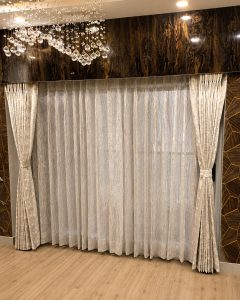
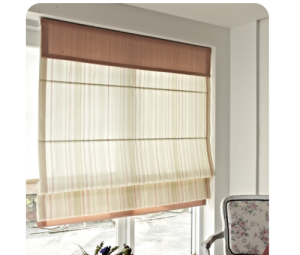
Almost every curtain conversation in our showroom starts with fabric. It should start with the heading. The heading — the way the top of the curtain is finished and hung — decides how the fabric falls, how much material you actually need, whether the curtain glides or drags, and how the window reads from across the room. Choose it last and you end up compromising. Choose it first and everything else follows.
Two styles account for the overwhelming majority of what we stitch in Kolkata: eyelet and pinch pleat. Here is how we help customers decide between them, window by window.
What a curtain heading actually does
A heading is not decoration. It is the engineering at the top of the curtain. It controls three things:
- Fold structure — whether the folds are soft and rounded or sharp and tailored.
- Fullness — how many times the window width you need in fabric. This is the single largest driver of your final cost.
- Hardware — whether the curtain runs on a visible rod or a concealed track.
Get the heading right and a mid-priced fabric looks expensive. Get it wrong and an expensive fabric hangs badly for the next ten years.
Eyelet curtains: the practical, everyday choice
Eyelet curtains (also called grommet curtains) have metal rings punched directly into a reinforced band at the top of the fabric. The rod passes through the rings, and the fabric falls in deep, even, wave-like folds between them.
Why they work well in Kolkata homes:
- They move easily. Metal rings slide on a metal rod with almost no friction. In a flat where the living room curtain is opened at 7 AM and closed by 6 PM every single day, this matters more than people expect.
- They suit printed and patterned fabric. The regular, predictable fold spacing lets a print stay legible instead of disappearing into gathers. If you have fallen for a block print or a large botanical, eyelet is usually the safer heading.
- They use less fabric. Typically around two times the window width, against up to two-and-a-half for a full pinch pleat. On a wide living room window that difference is real money.
- They are low-maintenance. No hooks to detach at wash time — lift the rod, slide the panel off, done.
Where eyelet falls short: the rod is always visible, so it becomes part of the design rather than disappearing. Eyelets also cannot be used with a ceiling-recessed track, which rules them out of most fully concealed pelmet installations. And on very heavy velvets or thick blackout linings, the ring band can begin to sag over the years unless the header is properly reinforced — something worth asking about wherever you buy.
Pinch pleat curtains: the tailored, formal choice
Pinch pleats are stitched — groups of two or three folds pinched together by hand at regular intervals, hanging from hooks that clip into a track or into rings on a rod. This is the traditional drapery heading, and it is what a formal drawing room usually wants.
Why we recommend it:
- The folds hold their shape. Because the pleat is sewn, not gathered by hardware, the curtain hangs in the same disciplined column whether it is open or closed, and whether it is new or five years old.
- It carries weight. Heavy velvet, thick cotton with blackout lining, layered blackout curtains — the stitched pleat distributes that load across the whole header instead of concentrating it at ring points.
- It works with concealed tracks. If you want the hardware to vanish behind a pelmet or into a false ceiling, pinch pleat on a track is the way to do it. It is also the standard heading for motorised curtain systems.
- It stacks tighter. Drawn fully open, a pinch pleat bunches into a narrower stack than an eyelet panel, so you lose less glass and less daylight.
Where pinch pleat falls short: more fabric, more labour, and slightly more friction when drawing. It also flatters plains, textures and subtle weaves far more than busy prints, which get lost inside the pleats.
Eyelet vs pinch pleat at a glance
| Eyelet | Pinch Pleat | |
| Look | Contemporary, relaxed waves | Formal, tailored columns |
| Typical fullness | About 2x window width | About 2x to 2.5x window width |
| Hardware | Visible rod only | Track or rod with rings |
| Best fabrics | Prints, cottons, mid-weight | Plains, velvets, heavy weaves |
| Daily operation | Easiest to draw | Smooth on a good track |
| Concealed pelmet | Not suitable | Ideal |
| Motorisation | Not suitable | Standard choice |
What about pencil pleat?
There is a third heading worth knowing. Pencil pleat uses a gathering tape sewn across the header, which you draw up with cords into tight, narrow folds. It is softer and more traditional than pinch pleat, it suits lighter fabrics well, and it is the heading we most often use for sheer curtains layered behind a heavier main curtain. It needs the most fabric of the three — commonly two-and-a-half to three times the window width — so it is generous rather than economical.
Choosing room by room
Living room, main window: if the window is wide and the curtain is drawn daily, eyelet on a good-quality rod is hard to beat. If the room is formal, the ceiling is high, or you want a concealed track, go pinch pleat.
Bedroom: pinch pleat, almost always. Bedrooms need weight, lining and a tight closure at the sides to keep morning light out, and a stitched pleat with a track handles all three better.
Balcony and verandah doors: eyelet. These get opened constantly, often with one hand, often while carrying something.
Kitchen and utility windows: eyelet in a washable cotton or poly-cotton. Fewer components, easier to take down and clean.
Offices, hotels and clinics: pinch pleat on a track. It is the only heading that reliably looks the same across forty windows, and it is far easier to service.
Get your measurements right before you decide
Heading and measurement are not independent choices. Eyelet needs the rod fixed high enough that the rings clear the window frame; pinch pleat on a track needs the track position finalised before the drop is cut. Deciding the heading after the fabric is already cut is how curtains end up two inches short. Our guide to measuring for curtains in Kolkata walks through it, and our tailors take the measurements themselves at your home so nothing is left to guesswork.
Frequently Asked Questions
Which is cheaper, eyelet or pinch pleat curtains?
Eyelet is usually the more economical of the two, for two reasons: it needs roughly two times the window width in fabric rather than up to two-and-a-half, and it involves less stitching labour. On a narrow window the gap is small. On a wide living room window it becomes noticeable.
Can eyelet curtains be used with a curtain track?
No. Eyelets need a rod to pass through the rings. If your design calls for a concealed track behind a pelmet or in a false ceiling, you need a pinch pleat or pencil pleat heading instead.
Which heading is best for blackout curtains?
Pinch pleat on a track. Blackout performance depends on closing the gaps — at the sides, at the top, and between panels — and a track lets the curtain run closer to the wall than a rod does. Eyelet curtains leave light gaps at the rod line.
Do eyelet curtains work with motorised systems?
Not practically. Motorised curtain tracks are built around carriers that hook into a pleated heading. If automation is on your list, plan for pinch pleat from the start.
How many eyelets should a curtain panel have?
It depends on panel width, but the count is always kept even so that both edges of the panel turn towards the wall and the folds face consistently. Our tailors calculate the spacing per panel rather than using a fixed number.
Which heading looks best with printed curtains?
Eyelet. The even, wave-like folds keep the pattern readable. Pinch pleats bunch the fabric at the top, which chops up a large print.
See both hanging before you decide
A heading is very hard to judge from a photograph. The honest answer is that you need to stand in front of both, in the fabric you are actually considering, and see how each one falls. That is what our showroom is for.
Avikar has been dressing windows in Kolkata since 1971, with over 5,000 curtain fabrics on the floor and made-to-measure stitching and installation handled in-house. Bring your window dimensions, or ask us to visit and measure.
Avikar Furniture & Furnishings
46 Central Avenue, Kolkata 700012
Open Monday to Saturday, 10:30 AM – 7:00 PM
Call or WhatsApp: 8080095551 | Message us on WhatsApp
For more on choosing fabric, fit and style, start with our complete curtains buying guide for Kolkata, or browse the Avikar curtain store.