
A padded headboard is one of the very few pieces of soft furnishing you touch every single night. It is also one of the few that people order from a photograph, without asking what is inside it, how it is fixed to the wall, or what it will look like after three Kolkata monsoons. Two years on, there is a dark halo on the fabric where everybody’s head rests, or the panel has picked up a musty smell that no amount of airing shifts.
Neither of those is bad luck. Both are decisions made — or not made — at the order stage. We have been padding and upholstering headboards from our Central Avenue showroom since 1971, in old Bowbazar flats with two-foot brick walls and in new Rajarhat apartments with block partitions and false ceilings, and it comes down to the same handful of choices every time. Here is how to make them.
What is actually inside a padded headboard
Three layers, and each one is a separate decision that you are entitled to ask about before you pay.
The base. A rigid board — usually 12mm to 19mm plywood or MDF — cut to your bed size. This is what everything else hangs off. On a wall-mounted panel it also carries the entire weight, so the board and the fixings matter more than they do on a headboard that simply sits behind the bed.
The padding. Foam, sometimes with a thin layer of polyester wadding over it to soften the edges and stop the foam profile showing through a light fabric. This is the layer most quotations are vague about, and the one that decides whether the headboard still feels the same in year five.
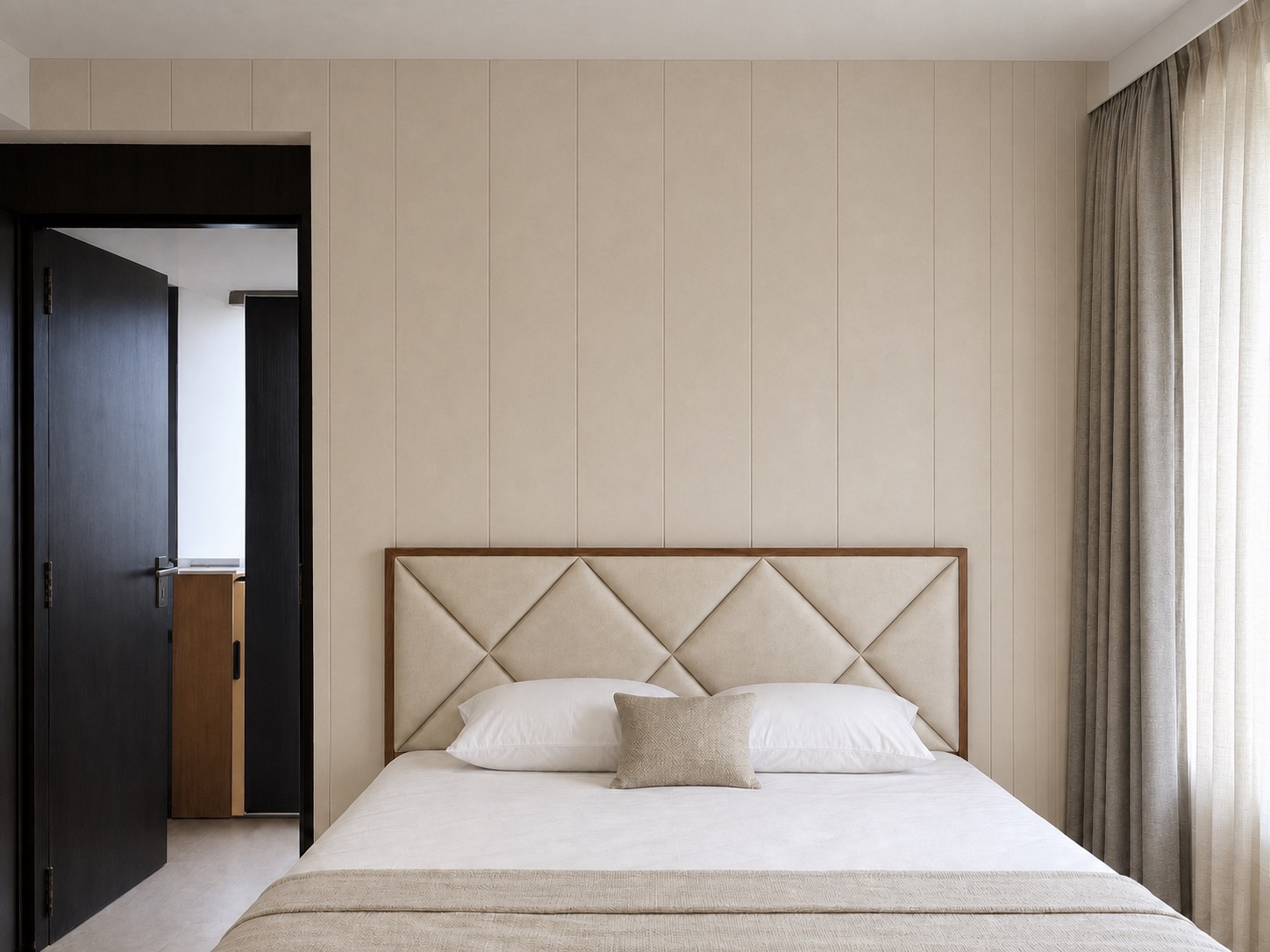
The cover. Fabric, pulled and stapled over the padding, in one of three broad treatments: plain, channelled into vertical flutes, or buttoned into a diamond pattern. The treatment changes the price meaningfully, because buttoning and channelling are hours of hand work, not a fabric upgrade.
The wall behind your bed decides more than the fabric does
This is the part no guide written in London or Los Angeles will tell you, and it is the single most common reason an upholstered headboard fails in this city.
Go and put your hand flat on the wall behind your bed. If that wall is an external wall, or backs onto a bathroom, or sits under a terrace, there is a good chance it holds moisture for several months of the year. A foam-and-fabric panel pressed tight against a damp wall is a sponge with no way to dry. You get mildew on the back of the board first, then the smell, then black spotting that comes through the face fabric — and by that stage the panel has to be stripped and rebuilt, not cleaned.
The fix is unglamorous and completely effective. On a wall you suspect, we mount the panel on battens so it stands clear of the plaster with an air gap behind it, and we seal the back face of the board rather than leaving raw ply against masonry. It costs very little at the making stage and it is close to impossible to retrofit later. If a supplier quotes you for a headboard without ever asking which wall it is going on, that is worth noticing.
Foam: density matters more than thickness
Most people ask for thickness. Thickness controls how the headboard looks; density controls how long it lasts.
Low-density foam feels wonderful in the showroom and then compresses permanently where shoulders and heads rest against it. Within a couple of years you have two flat patches at pillow height on an otherwise plump panel, which is far more visible than a headboard that was firm from the start. For a headboard — which is leaned on, not sat on — a firmer, higher-density foam holds its shape and its edges much better.
On thickness, a broad rule: around 25mm to 50mm gives a crisp, tailored panel with clean corners, which is what you want for a channelled or framed design. Go beyond that and the look becomes deliberately plush, which suits deep diamond buttoning but needs the extra padding to be intentional rather than accidental. Where thickness genuinely matters is comfort — if you read in bed, a thin panel over ply is a hard surface behind your neck, and you will notice it every night.
Ask two questions of any quotation: what is the foam density, and is there a wadding layer over it. If the answer to both is a shrug, the headboard is being priced on fabric alone.
Fabric: hair oil is the real enemy at head height
Every foreign guide to headboard fabric talks about wear and colour. In an Indian bedroom the actual problem is oil — coconut, almond, whatever the household uses — transferring off hair, night after night, into exactly the same band of fabric. It is why so many headboards look tired long before they look worn.
Three things help, and all three are decided before the fabric is cut.
Choose a tight weave. Open, slubby, loose-woven fabrics wick oil deep into the yarn and hold it. A dense, flat weave keeps more of it on the surface where it can be lifted.
Choose a stain-resistant finish where one is offered. Our fabric collection includes spill and stain resistant, eco-friendly options, and a headboard is exactly the application that justifies them. It buys you time to blot a mark before it sets.
Be realistic about colour. Pale ivory and cream photograph beautifully and show oil first. Mid-tones and textured weaves in the middle of the value range hide the inevitable far better than either very pale or very dark fabric. Velvet is the exception people ask about constantly: it looks superb, and it also shows every mark and every press of the pile, so it works best in a guest room or a bedroom where nobody sits up against it.
If you want the detail on weave, rub counts and performance finishes, our guide to upholstery fabrics in Kolkata goes through it properly, and the same logic applies to a headboard as to a sofa.
Wall panel or headboard fixed to the bed?
These are two different products and they solve different problems.
A bed-fixed headboard bolts to the existing bed frame or replaces the timber board on it. It moves with the bed, which matters if you rearrange rooms or move house, and it is the straightforward choice when the bed is good and only the headboard is dated.
A wall-mounted panel is fixed independently of the bed and can be far wider and taller than the bed itself — up to a full feature wall. It hides an uneven or patched wall, it lets you keep a low platform bed, and it gives the room a designed edge that a bed-width board cannot. The trade-offs: the fixing has to reach something structural, and it is not coming with you when you move.
The fixing point is where wall panels go wrong. In older Central and North Kolkata buildings, solid brick and lime plaster will take a fixing well but drills unpredictably and needs the right plug. Newer flats often use lightweight blocks or a plasterboard partition, where a standard screw into board alone will pull out under load with someone leaning back against it. And a gypsum false ceiling will hold nothing at all — the fixing has to reach the slab behind, or a timber batten built in for the purpose. This is worth planning before the ceiling is boarded, in the same way a recessed curtain pocket has to be.
Size it to an Indian bed, not an American one
Almost every headboard sizing guide that ranks in search is written to US or UK mattress sizes, which do not match what your bed actually is. These are the standard Indian mattress widths, and sensible headboard dimensions against each.
| Bed | Mattress width | Headboard fixed to bed | Wall panel width | Height above mattress |
| Single | 36 in (3 ft) | 38–40 in | 48–60 in | 24–30 in |
| Double | 48 in (4 ft) | 50–52 in | 60–72 in | 24–30 in |
| Queen | 60 in (5 ft) | 62–64 in | 78–96 in | 26–32 in |
| King | 72 in (6 ft) | 74–76 in | 90–108 in | 28–36 in |
| Feature wall | any | — | full wall | to ceiling or to picture rail |
Two practical notes on that table. Height is measured above the finished mattress, not above the bed base — a thick mattress or a mattress topper can swallow four inches of a headboard you have already paid for, so measure with the bed made up as you actually sleep in it. And on a wall panel, resist centring the panel on the wall if the bed is not centred on the wall; the panel should be centred on the bed, because that is the alignment the eye reads.
Padding over an existing headboard: when it works
Plenty of Kolkata bedrooms have a solid teak or sheesham bed that is structurally perfect and visually dated — a plain, hard timber board that nobody wants to lean on. Padding over it is usually the better decision than replacing the bed, and it is a fraction of the cost.
It works when the existing board is flat, sound, and tall enough. It does not work when the board is carved, curved or cut into a shape, because padding flattens detail rather than following it — you lose the carving and gain a lumpy outline. In that case the honest answer is a separate wall panel behind the bed, leaving the carved headboard visible in front of it, or a new board made to the same footprint.
The same reasoning we apply to re-covering a sofa rather than replacing it applies here: if the frame is good, keep the frame. It is also why we would rather look at a photograph of your bed on WhatsApp before quoting than guess from a size.
How it works at Avikar
Everything is made to your bed, not bought in a size. You choose the fabric at the showroom with our colour consultant — headboards draw from the same fabric library as our curtains and upholstery, which includes D’Decor, Gem and V&J alongside our own ranges, so it is possible to relate the headboard to the curtains and the bedroom wallpaper instead of matching them from memory. A technician then visits your home to measure the bed, the wall and the fixing conditions, the panel is built in our own workshop, and our own team delivers and installs it. We do not outsource the fitting, which is why we are willing to be particular about the wall.
We have reupholstered more than 1,000 pieces of furniture and served over 6,500 homes across Kolkata, and we hold a 4.7 rating on Google. The headboard is usually the last thing in the room to be decided and the first thing anyone sees, so it is worth ten minutes of proper conversation.
See the full service on our headboard padding and upholstery page, or read how we approach custom upholstery and reupholstery more broadly.
Frequently Asked Questions
How thick should the foam on a padded headboard be?
For a crisp, tailored panel, roughly 25mm to 50mm of foam gives clean corners and a defined edge. Deeper padding suits diamond buttoning and a deliberately plush look. But thickness is the less important number — foam density is what stops the panel developing permanent flat patches at pillow height, so ask about density before you ask about thickness.
Will an upholstered headboard get damp or smell during the Kolkata monsoon?
It can, if it is fixed flat against a wall that holds moisture — an external wall, a wall shared with a bathroom, or one under a terrace. Foam and fabric pressed against damp plaster cannot dry out, and mildew starts on the back of the board where you will not see it until you smell it. Mounting the panel on battens with an air gap behind, and sealing the back of the board, prevents it almost entirely. It has to be done at the making stage, not afterwards.
Can you pad the headboard on my existing bed, or do I need a new one?
If the existing headboard is flat, sound and tall enough, it can usually be padded and upholstered in place, which costs far less than a new bed. If it is carved, curved or shaped, padding will flatten the detail — in that case a separate wall panel behind the bed, or a new board made to the same footprint, gives a better result. Send us a photograph on WhatsApp and we can tell you which applies.
Which fabric is best for a headboard in an Indian bedroom?
A tight, dense weave in a mid-tone, ideally with a stain-resistant finish. The specific problem in Indian homes is hair oil transferring into the same band of fabric night after night, and loose, open weaves wick it in and hold it. Very pale fabric shows it first; very dark fabric shows dust and lint. Velvet looks superb but marks and presses easily, so it is best in a room nobody sits up against.
Can an upholstered headboard be cleaned?
Surface marks can be blotted and spot-cleaned, and regular vacuuming with an upholstery brush does more good than most people expect. What cannot be undone is oil that has soaked through the weave into the foam, or mildew from a damp wall — both of those mean re-covering. That is not a disaster: the board and the padding are reusable, so re-covering an existing headboard in new fabric is a genuinely economical way to refresh a bedroom.
Do upholstered headboards attract dust mites or bed bugs?
A headboard is no more attractive to them than a mattress or a sofa, but a padded panel is harder to inspect than a bare timber board, so the practical advice is to make it inspectable. A wall panel mounted with a gap behind it can be vacuumed around; one sealed tight to the wall and to the floor cannot. Vacuum the face and the top edge when you change the bedding and it is a non-issue.
Should the headboard be fixed to the wall or to the bed frame?
Fix it to the bed if you want it to move with the bed and the existing frame is good. Fix it to the wall if you want a panel wider or taller than the bed, if the wall behind is uneven or patched, or if you have a low platform bed. Wall fixing depends entirely on what the wall is made of — solid brick, lightweight block, a plasterboard partition and a gypsum false ceiling all need different fixings, and the last of those will hold nothing unless the fixing reaches the structure behind it.
See the fabrics in person
Bring a photograph of your bed and the wall behind it, and we will tell you honestly whether to pad what you have or start again. Fabric choices are much easier to make with the samples in your hand.
Avikar Furniture & Furnishings
46 Central Avenue, Bowbazar, Kolkata, West Bengal 700012
Call or WhatsApp: 8080095551 · Message us on WhatsApp
Serving Kolkata since 1971
You may also want to read our guide to furnishing a whole home in Kolkata, or, if the bedroom windows are next on the list, how to choose blackout curtains.