
Wallpaper is the fastest way to change a room, and it is also the finish we are asked to rescue most often. Rarely because the wallpaper itself was poor — most of what sells in Kolkata is decent material. It fails because it went onto a wall nobody tested. The pattern gets chosen in twenty minutes, the wall gets ten seconds, and eleven months later a corner lifts.
We have been furnishing Kolkata homes from 46 Central Avenue since 1971, and the honest version of this conversation starts with the wall rather than the catalogue. What follows is written for a home in this city specifically: brick and lime plaster in the older parts of town, hollow block and RCC in the newer flats, nine humid months a year, and a monsoon that finds every weakness in an external wall.
In Kolkata, the wall decides before the pattern does
Wallpaper is a dry-wall finish. It is paper or vinyl held to plaster by a film of adhesive roughly as thick as a coat of varnish, and that film is the only thing between your design and whatever the wall is doing. If the wall carries moisture, the adhesive lets go. It does not fail all at once either — it fails quietly, from behind, and the bubble you eventually notice is weeks behind the actual damage.
So before you look at a single sample, work out what kind of wall you are papering.
Internal partition walls — between two rooms of your own flat, dry on both sides — are the safest surface in the house. External walls, especially the south-west face that takes both the afternoon sun and the driven rain, are the riskiest. Party walls shared with the building next door, common in older Central and North Kolkata, sit somewhere between the two and depend entirely on the condition of the neighbour’s side, which you have no way of inspecting. Walls backing a bathroom or a kitchen sink carry plumbing and should be treated as suspect until proved otherwise.
A useful test costs nothing. Tape a square of thick polythene, about a foot across, flat to the wall on all four edges and leave it two days. Then lift it. Moisture on the wall side of the plastic means the wall itself is releasing damp and no adhesive will hold there. Moisture on the room side means humid air is condensing on a cold surface, which is a different problem with a different answer. Dry on both faces means you can go ahead.
The other sign worth knowing is a white powdery bloom on the plaster, often with paint blistering just above skirting height. That is salt arriving with rising damp, and it is the one condition where we will tell you not to paper at all until it has been dealt with properly.
Tell the three kinds of damp apart before you order anything
People say “damp wall” as though it were one condition. It is three, and only one of them is compatible with wallpaper.
Rising damp travels up from the ground through the wall. It affects ground floors and older buildings without an effective damp course, it stops at a fairly level height — usually somewhere between two and four feet — and it carries salts with it. Wallpaper over rising damp is money spent twice.
Penetrating damp comes in from outside: a crack in the render, a blocked rainwater pipe, a failed chhajja, a leaking joint. It shows as a patch rather than a band, it is worst during and just after rain, and it is genuinely fixable — but from outside, not from your side of the wall. Fix the source, let the wall dry through a full dry season, then paper.
Condensation is the one most often misread. Warm humid air meets a cold surface and gives up its moisture there. In an air-conditioned Kolkata bedroom that surface is the inside face of an external wall, and it is at its worst in the sticky weeks either side of the monsoon, when the AC is working hard against very humid outside air. Condensation is a ventilation and surface-temperature problem. Paper over a wall that condenses and it will grow mould behind the sheet long before anything lifts at the edge.
None of this needs a specialist. It needs someone to stand in the room, look at where the marks sit and how high they reach, and ask what is on the other side of that wall. That is what a measurement visit is actually for.
The PVC trap: washable is not the same as breathable
Nearly every wallpaper sold in this city is described as PVC-coated, washable and moisture-proof, and in a narrow sense all three are true. A vinyl surface takes a wipe with a damp cloth, and water landing on the face will not soak in. What the description leaves out is direction.
A vinyl face behaves close to a vapour barrier: it stops moisture crossing it. On a sound dry wall that is a real advantage, and it is why we use it in passages, children’s rooms and anywhere a hand or a switch plate gets touched a hundred times a week. On a wall holding any moisture at all it is precisely the wrong choice, because the moisture in the plaster now has nowhere to go except sideways into the adhesive. That is the mechanism behind almost every photograph of black speckling we are sent — on a wall the owner was assured was moisture-proof.
The working rule is short. Vinyl and PVC finishes belong on walls you are confident about, where washability is the point. Non-woven and breathable papers belong on walls you are less certain of, because they let a marginally damp wall dry through instead of sealing it in. Anyone who tells you a coating makes a damp wall safe to paper is selling rather than advising.
Where wallpaper genuinely earns its place
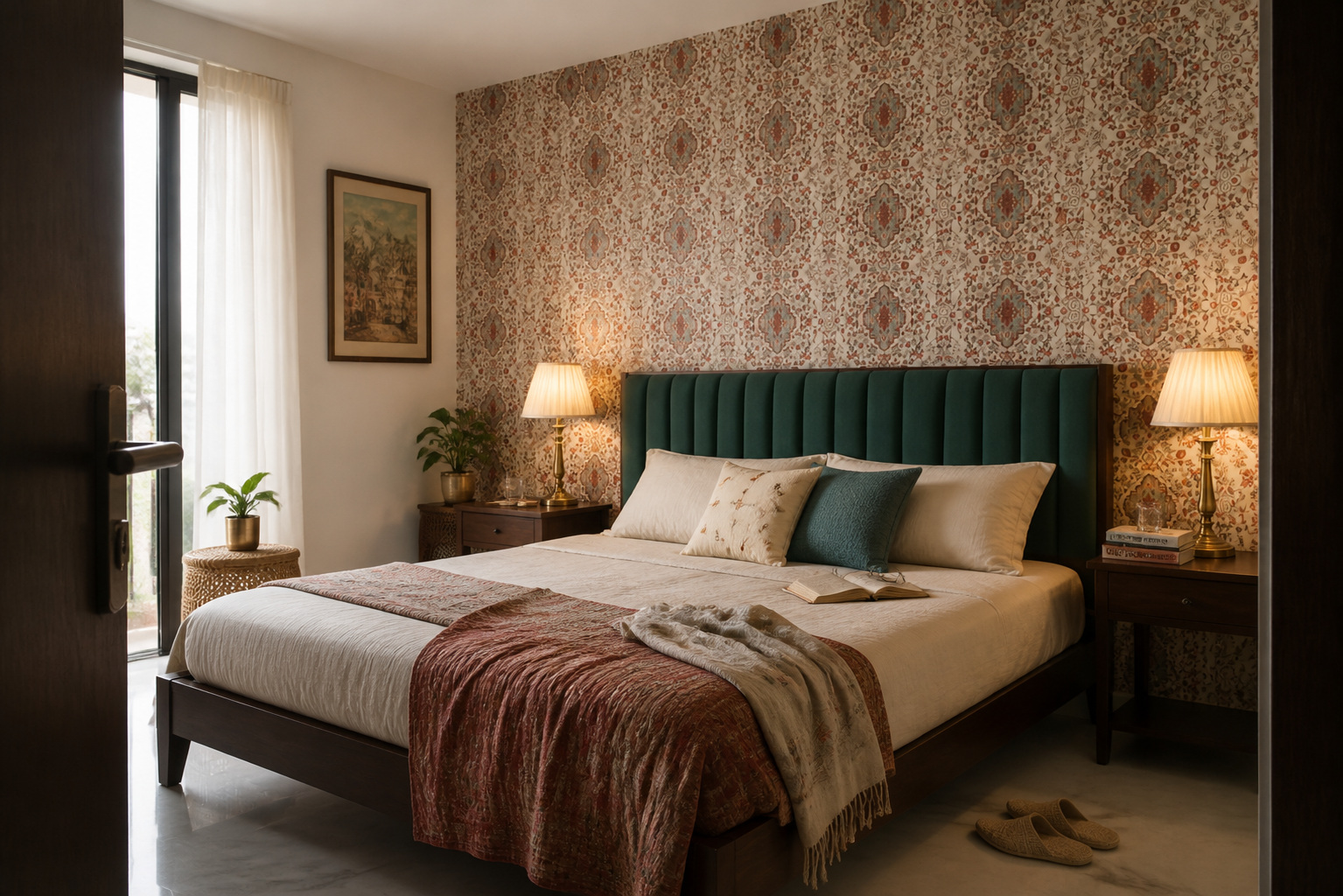
Used on the right surface, wallpaper does something paint cannot. It carries pattern, depth and a texture you can read from across the room, and it does it without the four-day disruption of a full repaint.
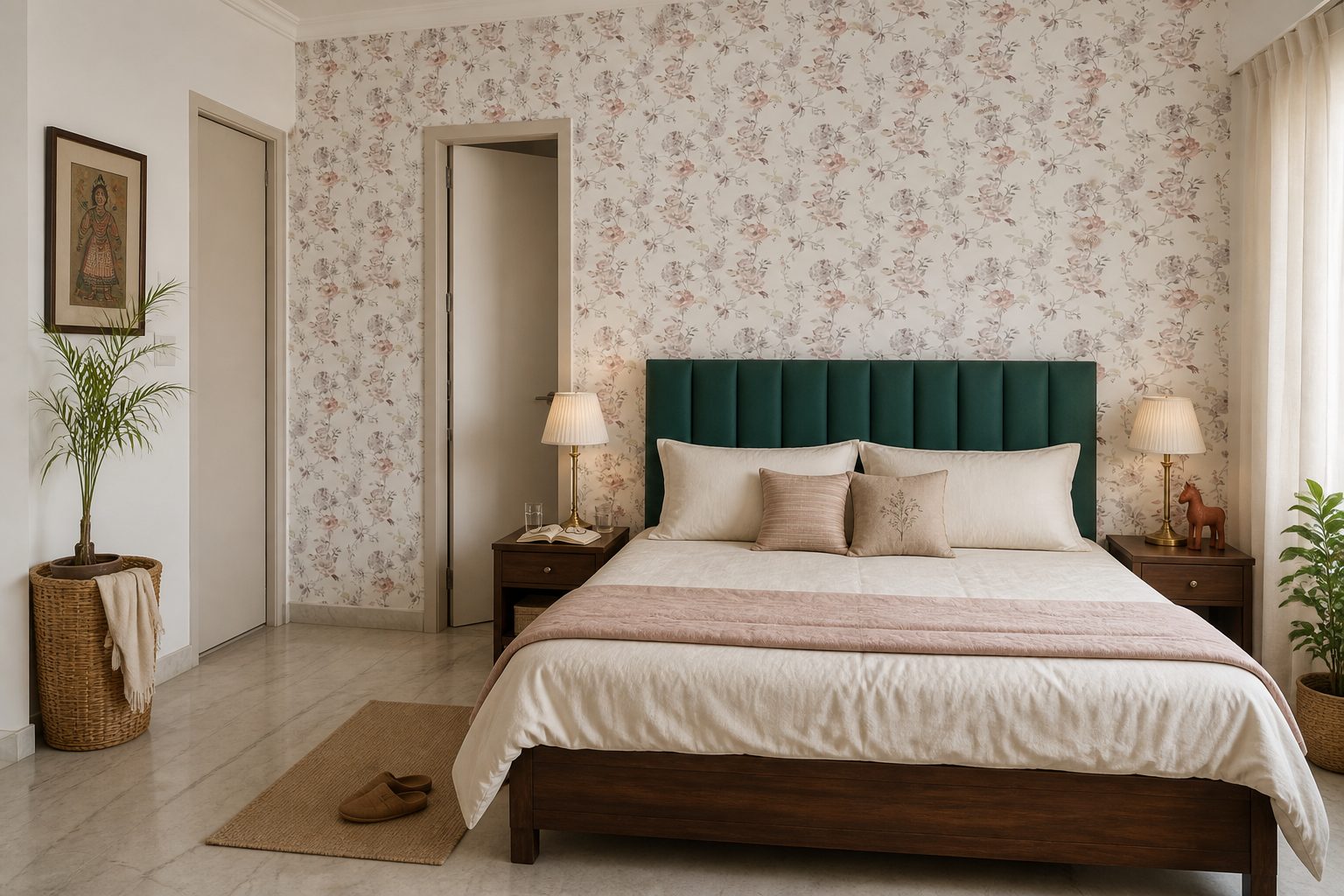
The wall behind the bed is the strongest candidate in most homes: it is internal in nearly every flat layout, it is the first thing you see entering the room, and it is the one wall in a bedroom that is never in direct sun. The wall behind a television or a console in the living room comes next, for the same reasons. A dining wall works well where the room has no natural focal point. And a stairwell or long passage wall — dead space that paint only ever makes duller — is often the single best return on a small quantity of material.
Customised and large-format printed panels have widened this further. A mural sized to one wall, a heritage motif, or a photograph printed to your own dimensions all become possible once the wall itself has been measured properly, which is why we measure before we quote rather than after.
Where we tell people not to use it
This is the part most wallpaper sellers leave out, so here it is plainly.
Bathrooms. Steam, splash and, in most Kolkata flats, one small ventilator doing all the work. Even a vinyl paper will lift at the seams here within a season or two. Tile, paint or a PVC panel instead.
The wall behind the kitchen platform and hob. Cooking oil vapour settles as a film that no wipe fully removes, and heat works the seams loose. Tile or a wipeable paint.
Balconies, covered verandahs and any wall that takes driven rain. A covered verandah in Kolkata is not an indoor space in July. Wallpaper is an interior finish.
The lower band of a ground-floor wall in an older building. If salts are coming through, they will come through whatever you stick over them.
Any wall you already know is damp and are hoping to cover up. Wallpaper is a finish, not a treatment. Covering damp does not slow it; it hides it while it spreads.
Saying no to a few of these every month costs us work in the short term and saves the customer a repeat job, which is the trade we would rather make.
Wallpaper, paint or panelling: an honest comparison
| Finish | Best for | Tolerates a marginal wall? | Watch out for |
|---|---|---|---|
| Non-woven / breathable wallpaper | Bedroom and living room feature walls; walls you are slightly unsure about | Best of the papers — lets the wall dry through | Less scrubbable than vinyl; keep it away from hands and switches |
| PVC / vinyl-coated wallpaper | Passages, children’s rooms, dining walls, anywhere that gets touched | No — it seals moisture in | Only on a wall you have tested and trust |
| Customised mural or 3D print | One statement wall with a clear focal point | Depends on the base material chosen | Needs accurate wall measurements before printing; a misprint cannot be re-cut |
| Emulsion paint | Whole rooms, ceilings, rented flats, anything you may change soon | Better than paper, but damp still shows through | Flat colour only; texture and pattern have to come from somewhere else |
| Fluted or wood wall panelling | Bed walls and TV walls where you want depth rather than pattern | Fixed on battens, so the wall can breathe behind it | Costs more; eats a little floor depth |
| Upholstered fabric panelling | Behind a bed, as a headboard that runs wall to wall | Only with a batten mount and an air gap | Never flat-fixed to an external or bathroom-backing wall |
Preparation is most of the job
The material is the smaller half of a wallpaper job. What decides whether it still looks right in year five is what happened to the wall in the week before.
New plaster and POP must dry first. Weeks, not days — and considerably longer if the work was done in the monsoon than if it was done in December. Papering a green wall traps the water that is still leaving it.
Old distemper and chuna have to come off completely. They are chalk-bound and holding on to very little. Wallpaper adhesive is stronger than that bond, so the paper will happily pull the old finish off the wall and hang there with it.
Fill and sand properly. Wallpaper shows hollows and ridges more than paint does, and a satin, metallic or pale plain ground shows them most of all. Every dent you can feel with a palm will be visible under raking light afterwards.
Prime. A wall primer evens out how fast different patches of plaster drink the adhesive. Skip it and one section grabs while the next is still slipping, which is how seams open.
One wall or the whole room? Ceiling height decides
The high-ceilinged rooms of old Central and North Kolkata houses — eleven, twelve, sometimes thirteen feet — can carry a fully papered room and a large-scale pattern without closing in. They were built for it.
A newer flat in Salt Lake, New Town or the southern suburbs is usually around ten feet, and less once a gypsum false ceiling has taken its cut. There, one wall is almost always the right answer, with a smaller repeat. Papering four walls of a ten-foot room in a bold design makes it feel like a corridor.
Choose the wall you face as you walk in — behind the bed, behind the television — and avoid the wall containing the main window. Backlighting flattens pattern and throws every seam into relief, which is the one lighting condition wallpaper cannot flatter.

One pattern in the room, not three
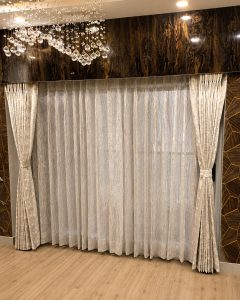
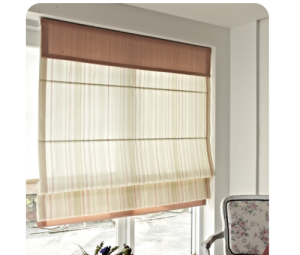
This is the rule that separates a room that looks designed from one that looks busy, and it is easy to state: if the wall is patterned, the curtains stay plain and the upholstery stays plain. If the curtains are the pattern, the wall stays quiet.
The same applies to anything else you are adding at the same time. A buttoned or strongly patterned upholstered headboard against a patterned wall gives you two competing motifs at eye level. Against a papered wall, keep the headboard plain and let colour do the joining — pulling one shade out of the wallpaper into the headboard fabric or the curtain is worth more than any amount of extra pattern.
It is also why we prefer to look at wallpaper, curtain fabric and upholstery on the same table rather than across three separate visits. Shades that look adjacent on a phone screen very often are not.
Measuring, repeats and how much you actually need
A standard roll is around 53 cm wide and 10 m long, which yields roughly 57 square feet before any waste. That last clause is where estimates go wrong.
Every patterned wallpaper has a repeat, and each drop has to be cut so the pattern lines up with its neighbour. A small straight-match repeat wastes very little. A large half-drop repeat can waste a great deal, because every alternate drop starts partway down the design. Two papers costing the same per roll can therefore need quite different quantities for the same wall — worth asking about before you fall for the bolder one.
Two more things the imported guides never mention, because they describe homes that do not have them. First, order every roll from a single batch number: shade varies between print runs, and a top-up roll bought three weeks later will not match the wall it is joining. Second, a Kolkata wall is rarely a clean rectangle. Switchboards sit at odd heights, split-AC units and their pipe chases interrupt the top of the wall, window grilles project, and false-ceiling coving eats into the drop. Each of those is a cut, and each cut is a chance to break the match. It is the reason we measure walls in person, free of charge, rather than working from a photograph and a rough size.
Frequently Asked Questions
How long does wallpaper last in a Kolkata home?
On a sound internal wall, well prepared, comfortably several years of looking as it did on day one — and it will outlast a coat of emulsion in the same position. On an untested external or ground-floor wall it can fail inside a single monsoon. The gap between those two outcomes is almost entirely down to the wall and the preparation, not the price of the paper.
Will wallpaper make a damp wall worse?
A vinyl-faced one will, yes. It seals the moisture in and leaves it nowhere to go except into the adhesive and the plaster, which is how mould starts on the hidden back face. A breathable non-woven paper is more forgiving on a marginally damp wall, but neither is a treatment. If the wall is actively damp, deal with the cause first.
Can wallpaper be used in a bathroom?
We advise against it in a typical Kolkata bathroom — steam, splash and one small ventilator will find the seams. If you want pattern in a bathroom, tile or a PVC panel is the finish that survives. The same logic applies to the wall behind the hob.
Is wallpaper more expensive than paint?
Per square foot, usually yes at the outset. Over the life of the finish the gap narrows, because a papered wall generally goes longer before it needs attention than a painted one in the same position. The more useful comparison is what you are buying: paint gives you colour, wallpaper gives you pattern and texture that paint cannot produce at any price.
How much does wallpaper cost in Kolkata?
It turns on four things: the material (paper, non-woven, vinyl or a custom print), the size of the pattern repeat and therefore the wastage, the wall area after obstructions, and the condition of the wall, since preparation can be a small job or a large one. We would rather measure the wall and give you a real figure than quote a rate that changes the moment anyone looks at the room. Send photographs on WhatsApp or come into the showroom and we will work it out with you.
Can wallpaper be removed later without wrecking the wall?
Modern non-woven papers are designed to strip dry in full widths and generally leave the wall in reasonable order. Older paper-backed types, and anything stuck to an unprimed or distempered wall, are a different story — another reason primer matters, and a fair question to ask before you choose the material rather than after.
Can I have my own photograph or design printed?
Yes. Customised wallpaper is printed to the dimensions of your wall, which is exactly why the measurement has to be right the first time — a print sized to the wrong wall cannot be re-cut the way a curtain can. We take the measurements ourselves before anything goes to print.
How do I clean it?
A vinyl or PVC-coated surface takes a wipe with a barely damp cloth and a light hand around the seams. Non-woven and paper finishes want dusting rather than washing. In practice the stretch of wall that gets touched is the one beside the switchboard, which is a good argument for putting the washable material exactly there.
Come and see it on the wall, not on a screen
Wallpaper is one of the few finishes a phone screen genuinely misrepresents. Scale, sheen and the way a texture catches side light are all things you have to stand in front of. In our showroom you can compare 3D, floral, textured and PVC wallpapers side by side, and hold them against curtain fabric and upholstery at the same time — which is how the decision actually gets made.
Bring a photograph of the room, tell us which wall you have in mind and what sits on the other side of it, and we will tell you honestly whether it will hold. Our design consultation is free, our in-home wall measurement is free, and our own team measures, fits and finishes the job. Avikar has been Kolkata’s furnishings destination since 1971, more than 6,500 homes have furnished with us, and there is a washable, PVC and eco-friendly collection chosen with this city’s humidity in mind. You can see the range on our wallpapers page, or book a consultation.
Avikar Furniture & Furnishings
46 Central Avenue, Bowbazar, Kolkata, West Bengal 700012
Monday to Saturday, 10:30 AM to 7:00 PM. Sunday closed.
Call or WhatsApp: 8080095551
Parking available on request.
If wallpaper is one part of a larger plan, our guide to furnishing a whole home in Kolkata is the place to start, and the same wall-first thinking applies to upholstered headboards, wooden flooring and upholstery fabrics.