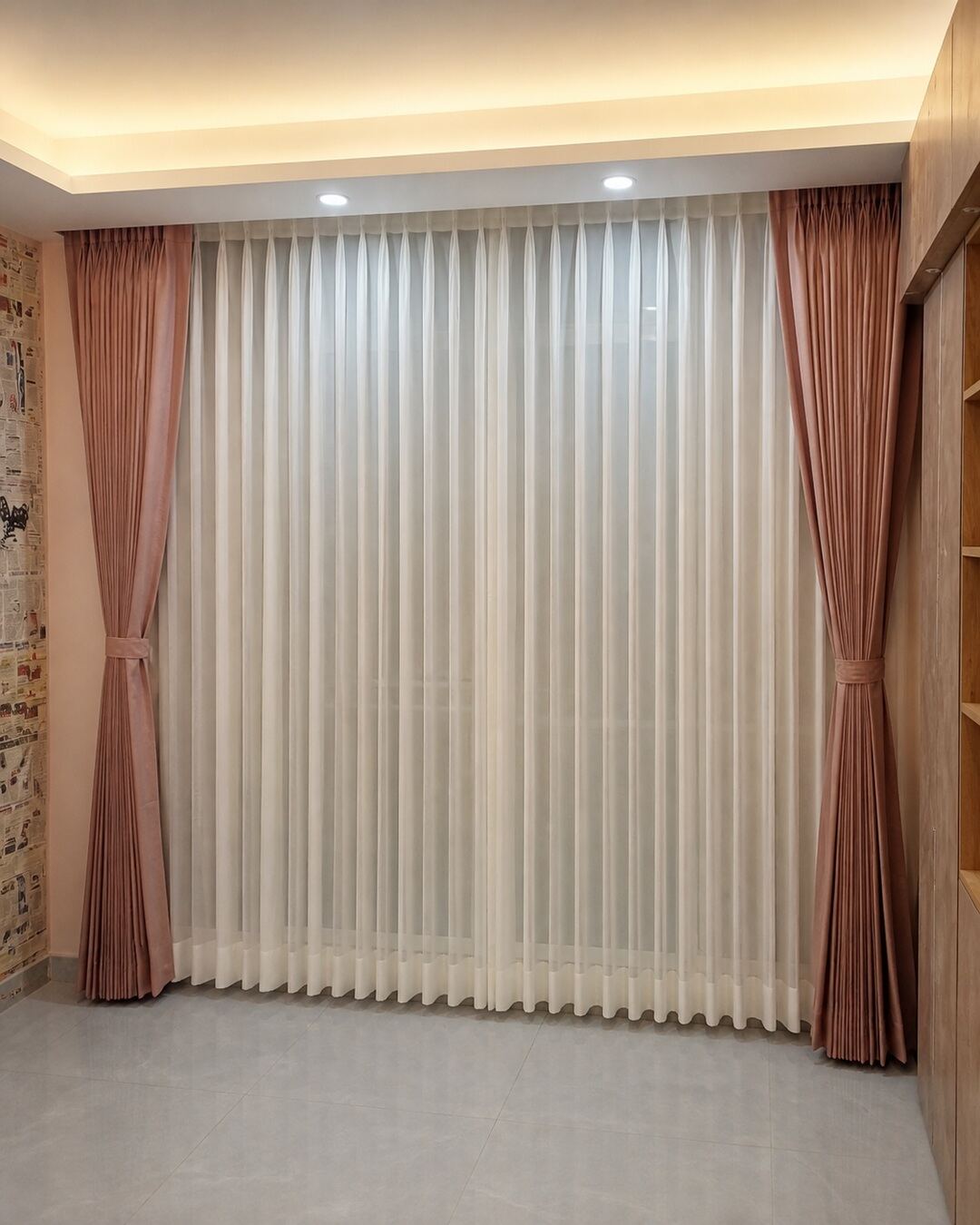

Ask ten people in Kolkata whether they should put up curtains or blinds and you will get ten confident answers, most of them borrowed from a magazine photographed somewhere it rains politely. We have been fitting both from Central Avenue since 1971, and the honest position is less satisfying and far more useful: this is not a decision you make for a home. It is a decision you make for a window.
Two windows in the same flat, three feet apart, will often want different things. One has a window air-conditioner sitting in the lower half of the opening. The other is a full-height balcony door. One faces the street and all its dust; one faces a shaft and never sees direct sun. The factors that actually settle it are rarely the ones the internet argues about.
What genuinely separates the two
Strip away the styling talk and the real differences are short, practical and easy to check against your own room.
| What you care about | Blinds | Curtains |
|---|---|---|
| Fine light control through the day | Strong. Raise in stages, or tilt slats to bounce light at the ceiling while keeping the view | Limited. Essentially open or shut, with sheers as the only middle setting |
| Real darkness for sleeping | Weak on its own. Light leaks down both edges, around the brackets and at every slat or vane join | The only reliable answer, provided the curtain is lined and hung wider and longer than the opening |
| Routine cleaning | Wipe in place with a damp cloth | Take down, wash or dry-clean, rehang |
| Monsoon damp | PVC and aluminium are indifferent to it; untreated timber is not | Heavy natural fabrics hold moisture and will smell before they visibly mildew in a shut room |
| Wide, short windows | Well suited. One unit spans the opening cleanly | Awkward. A lot of fabric width for very little drop, and it tends to look stubby |
| Tall windows and full-height doors | Workable, though a long drop gets heavy to operate by cord | This is exactly what they are for |
| Softening a hard, tiled, marble-floored room | Very little | Their entire purpose |
| Living under a ceiling fan | Vertical vanes and lightweight fabric blinds lift and knock together | A weighted hem hangs still |
The grille problem, and why half the blinds advice online does not apply here
Almost every window in this city has a safety grille. Guides written for homes in the UK, the United States or Australia never mention one, because those windows do not have them — and that single omission invalidates a good deal of their advice.
A blind is normally fitted inside the reveal, hanging close to the glass. A grille fixed to the inside face of that opening eats the depth the blind needs. If there is not a clear few centimetres in front of the grille, a roller will foul it on the way down and a Venetian will catch it the moment the slats tilt. This is the single most common reason a blind that looked fine on paper cannot actually be fitted, and it is why our technician measures the depth of the reveal in front of the grille, not just the width and drop. There is more detail on that in our guide to measuring for blinds in Kolkata.
There are two ways out. Fit the blind outside the reveal, on the wall above the opening, which needs clear wall and a wider blind. Or use a curtain, which hangs past the whole assembly — grille, frame, window unit and all — and never has to negotiate with any of it.
The same logic settles the window air-conditioner question. A unit sitting in the opening rules out an inside-fit blind completely. A curtain on a rod above the opening simply covers the wall and can be drawn clear of the vent.
What the monsoon decides for you
For several weeks a year the air here sits above ninety per cent humidity, and fabric in a closed, unaired room behaves accordingly. It will smell musty long before anything is visible on it. That is not an argument against curtains — it is an argument about which rooms they belong in.
Anywhere that meets water or steam directly, the answer is a wipeable blind rather than fabric: kitchens, bathrooms, utility areas, and any balcony door that takes rain-spray through the grille. A PVC roller blind is the standard answer for all of those. In a living room or bedroom where the air moves and the AC runs, fabric is entirely fine, and washing it on schedule is what keeps it that way — our guide on cleaning curtains in Kolkata covers what can go in a machine and what should not.
One caution on timber. A wooden blind is the warmest-looking option we sell, but wood and driving rain do not negotiate. Put it on a window that stays dry.
Dust, and the kind of effort you are actually willing to make
This decides the question more often than anyone admits, and it is worth being honest with yourself about it.
Blinds show dust. It settles on every horizontal surface and it is visible within days on a main-road flat. A wooden Venetian facing a busy street is a small weekly job, slat by slat. Roller and vertical blinds have far less horizontal surface and suffer much less.
Curtains hide dust. They hold a remarkable amount of it invisibly for months, and then it all arrives at once when you finally take them down, which happens perhaps twice a year and is a whole afternoon’s logistics.
So: blinds ask for small, frequent effort and reward you by always looking clean. Curtains ask for rare, large effort and look fine in between whether or not they deserve to. Choose the one that matches how your household actually runs, not how you intend it to run.
Cost: why the answer depends on the shape of the window
We are not going to quote you a figure here, because the honest one depends on fabric, finish and final measurements. But the structure of the pricing is worth understanding, because it explains why blanket claims that one is cheaper than the other are meaningless.
A blind is priced by the area of the finished blind. A curtain is priced by the running length of fabric, plus stitching, plus the track or rod — and the fabric quantity is driven by the width being covered and the fullness you want, since a proper pleat needs roughly two to two and a half times the track width in fabric.
Follow that through and the consequence is clear. A wide, short window is inexpensive as a blind and disproportionately expensive as a curtain, because you are buying all that width for very little useful drop. A tall, narrow window is the reverse. A large balcony span usually comes out lower in blinds. The window shape, not the product, drives the number.
Room by room in a Kolkata flat
| Room | Usually the better answer | Why |
|---|---|---|
| Bedroom facing a street or the east | Lined blackout curtain, optionally over a roller blind | Only a lined curtain hung wide and long gives genuine darkness; a blind alone always leaks at the edges |
| Living room | Both, layered | Blind for daytime glare, curtain for evenings and for taking the hardness off a tiled room |
| Kitchen | PVC roller blind | Grease and steam wipe off a coated surface; fabric absorbs both and keeps them |
| Bathroom | PVC roller blind | Anything fabric stays damp for months of the year |
| Balcony door or full-height sliding | Vertical blinds, or curtains on a wide track | Vanes stack clear of the doorway; curtains work well if there is wall to stack onto |
| Study or work-from-home desk | Zebra or Venetian blind | You need screen glare cut in stages without losing the view entirely |
| Small window, puja room, stairwell landing | Sheer curtain | Light and air without exposure, and nothing mechanical to maintain |
Each of those has a fuller guide behind it: blackout curtains, vertical blinds, zebra blinds and sheer curtains among them.
Most homes end up using both, and that is not a compromise
The arrangement that works in the largest number of Kolkata living rooms is a blind on the glass doing the daytime work, with a curtain on a track above and wider than the opening doing the evenings, the darkness and the look. It is the same principle as the sheer-behind-curtain pairing in the photograph above: one layer manages light, the other manages the room.
It has a practical side-benefit too. When the curtains finally come down to be washed, the room is not sitting exposed to the street for two days while they are away.
Two honest cautions. Layering needs the reveal depth or the clear wall that the grille section above describes, so it has to be checked before it is promised. And it is two products, which means deciding which layer is doing the real work and putting the money there rather than splitting it evenly across both. If the decision is being made for a whole flat at once, our complete blinds buying guide and curtains buying guide go a level deeper on each side, and if you are considering automation, we have compared motorised blinds against motorised curtains separately.
Frequently Asked Questions
Are blinds cheaper than curtains in Kolkata?
It depends entirely on the shape of the window rather than on the product. Blinds are priced by the area of the finished blind, while curtains are priced by fabric length, stitching and track, with the fabric driven by width and fullness. So a wide, short window is usually cheaper as a blind, and a tall, narrow one is usually cheaper as a curtain. Anyone quoting you a flat rule without seeing the window is guessing.
Which is better for a bedroom, blinds or curtains?
For sleeping, a lined blackout curtain, hung wider and longer than the opening. No blind blacks out a room properly on its own, because light passes down both edges, around the brackets and at every slat or vane join. If you also want daytime light control, put a roller blind behind the curtain rather than instead of it.
Can you fit blinds if the window already has a safety grille?
Often yes, but it has to be measured first. An inside-fit blind needs clear depth in front of the grille, and if the grille sits tight against the inside face of the opening, a roller will foul it as it comes down and a Venetian will catch it when the slats tilt. The alternatives are to fit the blind outside the reveal on the wall above, or to use a curtain, which hangs past the grille entirely. Our technician checks reveal depth during the free in-home measurement precisely because of this.
Do blinds keep a room cooler than curtains?
Neither does much on its own, and the difference between them matters less than how tightly either one seals the opening. Heat arrives through the glass, so what helps is a dense covering fitted snugly with small gaps at the edges. A cellular honeycomb blind traps air in its cells, and a lined curtain hung close to the wall and run wide traps air behind it. A loose blind with two centimetres of gap on each side will underperform both.
Which is easier to keep clean in Kolkata’s dust?
Blinds, if you will actually do it. They wipe down in place in a few minutes, but they show dust within days and need doing regularly, especially horizontal slats on a main-road window. Curtains conceal dust for months and then need taking down, washing or dry-cleaning and rehanging. It is a choice between frequent small effort and occasional large effort.
Can you have both a blind and a curtain on the same window?
Yes, and it is what we fit most often in living rooms. The blind goes inside the reveal against the glass and handles daytime light; the curtain goes on a track above and wider than the opening and handles evenings, privacy and the look of the room. It needs enough reveal depth for the blind and enough clear wall above for the track, which is worth confirming at measurement stage.
Do blinds work under a ceiling fan?
Some do, some do not. Vertical vanes and lightweight fabric blinds lift and knock together when a fan runs over them on medium or high. Roller and Roman blinds, which hang as a single panel, are unaffected, and a weighted curtain hem stays put. If the fan sits directly over the window, that alone is often enough to settle the choice.
Come and see both on the same afternoon
The fastest way through this decision is to stop reading comparisons and stand in front of the two. Our showroom at 46 Central Avenue, Kolkata 700012 carries curtains and blinds under one roof, with over 500 fabric samples and blind finishes to handle, and a soft-interior designer and colour consultant who will go through your rooms with you at no charge. We are open Monday to Saturday, 10:30 AM to 7:00 PM.
If you would rather start at home, send us a photograph of the window on WhatsApp at 8080095551 or call the same number, and we will tell you honestly which of the two that particular window wants. Our technician measures on site, free of charge, and everything is made up and fitted by our own team rather than an outsourced one. You can also book a consultation or browse our curtains and blinds range first.