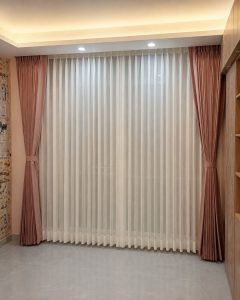
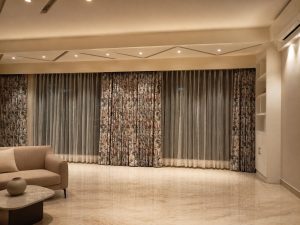
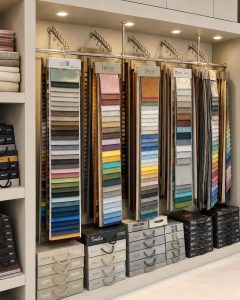
Almost every curtain conversation in our showroom opens the same way: what will this room cost? It is a fair question and an unfair one to answer across a counter, because the same window can be honestly quoted at figures that are multiples apart, depending entirely on decisions the customer has not made yet. We have been measuring, stitching and hanging curtains from Central Avenue since 1971, and the most useful thing we can hand you before you start shopping is not a price list. It is the ability to read a quote.
Search for curtain prices in Kolkata and you will mostly find wholesale directory listings quoting a rate per metre. Those numbers are real, and on their own they are close to useless, because nobody buys one metre. What you are actually buying is a quantity of fabric decided by your window and your choices, plus lining, plus stitching, plus hardware, plus fitting. Six things move that total. Here they are, in the order they matter.
1. The rate per metre tells you less than you think
The fabric rate is the number every shop leads with, and it is the one that explains the least. Two shops can quote an identical rate per metre and land at very different totals for the same drawing room, because the rate is per running metre, and how much running metre your window swallows depends on how wide the fabric is woven.
Curtain fabric reaches the Kolkata market in roughly two families: narrow width, generally somewhere between 44 and 54 inches, and wide width, usually around 110 inches or more. A narrow-width fabric has to be cut into several vertical drops and joined to cover a wide window, so a single panel may eat three or four drops. A wide-width fabric can often be run horizontally and cover the same window seamlessly, with far less waste. Ask for the width before you compare two rates. A per-metre figure with no width attached is not a price, it is a conversation starter.
2. Fullness is the multiplier nobody mentions
This is the single largest lever on your bill, and it is almost never discussed at the counter. A curtain is not cut to the width of the window. It is cut to a multiple of it, so that it gathers into folds instead of hanging like a bedsheet. That multiple is the fullness ratio.
At one and a half times the track width you get a curtain that looks acceptable while open and disappointingly flat once drawn, with pleats that collapse within a season. At twice the track width you get the standard we work to for most pleated headings: proper body, folds that hold their shape, a curtain that reads as a curtain. Sheers want more still, because the whole point of a sheer is the density of the gather. Go from one and a half to two and a half and you have not changed the fabric at all, yet your fabric bill has risen by two thirds.
When one quote comes in noticeably below another on the same fabric, fullness is the first place to look. It is the easiest place for a quote to be made cheap without anyone having to say so.
3. Pattern repeat adds metres quietly
If the fabric carries a large printed or woven motif, every drop has to be cut to the next full repeat so the pattern lines up across the joins and between panels. On a generous repeat that can add a real chunk to your meterage, and it is charged to you because it is genuinely consumed. Plains, small textures and self-weaves carry almost no such penalty. This is worth knowing before you fall in love with a large botanical: the fabric that costs the same per metre can cost meaningfully more per window.
4. Lining is a second curtain, and it is priced like one
Lining is charged by the metre, and it consumes broadly the same meterage as the face fabric. In effect you buy the window twice. People resist this until they understand what lining actually does, which in this city is a great deal.
A west or south-west facing window in Kolkata will fade an unlined fabric, and the damage is permanent. Lining takes that punishment instead. It also gives the curtain enough weight to hang in a straight column through a humid July, rather than clinging and creasing. And if you want a bedroom genuinely dark, blackout lining is the only honest route, because a dark-coloured face fabric on its own does not black out anything. Ordinary cotton lining, blackout lining and interlining sit at different rates, so decide this per room rather than for the whole house.
5. Stitching and heading style
Stitching is labour, and different headings are different amounts of it. An eyelet curtain is the quickest to make, needs the least fullness to look right, and is therefore the cheapest finish in the room. A pinch pleat costs more twice over: more hand work at the heading, and more fabric because it wants greater fullness to sit properly. Pencil pleat sits between them. We have written a fuller comparison of eyelet against pinch pleat if you are weighing the two.
Finishing matters too, and it is invisible in a photograph. Hand-slipped hems, mitred corners, weighted hems that keep the leading edge hanging true, properly turned side hems that do not roll: these are the difference between a curtain that still looks right in its fifth year and one that does not survive its second wash. Ask whether the hem is weighted. The answer tells you a lot about the rest of the workmanship.
6. The track or rod is a separate purchase, and not a small one
Customers routinely budget for fabric and forget the thing it hangs from. On a wide living-room window, decent hardware can account for a surprising share of the total. A decorative rod with finials is priced by length and finish; a concealed track is priced by system, and the good ones glide silently under load and take centre supports on long spans so they do not sag. Motorisation is a further step again.
Wall fixing and ceiling fixing are not the same job either, and newer Kolkata flats with false ceilings often need a recessed pocket planned before the ceiling closes. Our guide to curtain rods, tracks and brackets goes through the options properly.
The Kolkata details that quietly change the number
Two windows of identical width can cost quite differently here, and it is usually the ceiling that does it. An older Central or North Kolkata flat with eleven-foot ceilings and a floor-length curtain buys far more fabric per drop than a newer flat with nine-foot ceilings, even though the two windows measure the same across. Height is bought by the metre exactly as width is.
Then there are the fixtures. A safety grille set tight inside the reveal forces the track outside the opening and wider than you planned. A window air-conditioner in the lower half changes where the curtain can break. A balcony door needs the stack to clear the opening entirely or you will be fighting the curtain every evening. None of this shows up in an online estimate, which is why we measure before we quote. If you want to take your own first pass, our step-by-step measuring guide will get you close enough to budget from.
Ready-made or made-to-measure: where each one actually saves money
Ready-made is the sensible answer more often than a custom workroom likes to admit. For a standard-size window, a rented flat, a guest room, or anywhere you want curtains up this week, buying off the shelf is quicker and cheaper and there is no shame in it.
Made-to-measure earns its premium in three situations: when the window is not a standard size, which in Kolkata is most of them; when the drop matters, because a floor-length curtain that stops two inches short reads as a mistake forever; and when you need blackout or a specific heading that ready-made does not offer. We stitch made-to-measure in our own workshop here, and we have set out what actually happens between measurement and installation so there are no surprises. If you are still deciding between soft furnishing and a hard covering altogether, our blinds against curtains comparison takes that question window by window.
How to read two quotes side by side
Ask every shop for the same eight lines, and comparison becomes trivial. Fabric name and width. Fullness ratio. Total metres of face fabric. Lining type and metres. Stitching charge and whether it is per panel or per metre. Heading style. Hardware itemised, including brackets and supports. Fitting and delivery time.
Written that way, the cheaper quote very often stops being the cheaper quote. In our experience the gap between two honest quotations for the same window is rarely about margin. It is about fullness, lining and hardware, three things the customer was never asked about.
Where people overspend, and where they should not economise
The common overspends are easy to name: an expensive fabric on a window nobody looks at, motorisation on a window that is within arm’s reach, and a large repeat chosen without anyone mentioning what it does to the meterage.
The false economies are just as consistent. Cutting fullness saves money once and disappoints daily. Skipping lining on a sun-facing window costs you the fabric within a few seasons. Cheap hardware on a wide span sags, and replacing it means taking the curtains down. If the budget is tight, buy a simpler fabric at proper fullness with proper lining rather than a grand fabric hung thin. It will look better and it will last.
Frequently Asked Questions
Why does the shop quote per metre when I asked what my window costs?
Because fabric is bought and cut by the metre, and the number of metres your window needs is not known until the width, the drop, the fullness and the fabric width are all settled. Any shop that names a per-window figure before measuring is either working from a very narrow standard range or guessing. A proper quote converts your window into metres in front of you, and you should ask to see that arithmetic.
How much fabric does one window in a Kolkata flat usually take?
It depends far more on the fabric width and the fullness than on the window. The same opening can need three or four narrow-width drops per panel, or a single horizontal run of a wide-width fabric. Give any shop your track width, your finished drop and the heading you want, and they can tell you the meterage in a minute. Without the fabric width, nobody can.
Is stitching charged per panel or per metre?
Both conventions exist, which is precisely why you should ask. Per-panel pricing tends to favour large windows and penalise small ones, because there is a minimum amount of labour in any curtain regardless of size. Per-metre pricing behaves the opposite way. Neither is dishonest; they simply are not comparable until you know which one you are being quoted.
Are ready-made curtains always cheaper than custom?
Per window, usually yes. Per satisfactory window, not always. If your drop is non-standard and the ready-made panel finishes short, or the width is thin enough that the curtain does not close properly, you have bought something you will replace. Ready-made is genuinely the better buy on standard openings and in rooms where the curtain is functional rather than decorative.
Does blackout lining cost much more than ordinary lining?
It sits at a higher rate per metre than a plain cotton lining, and because lining runs to roughly the same meterage as the face fabric, the difference is multiplied across the window. It is worth it in a bedroom facing east or a street light, and generally not worth it in a drawing room, where most people find full blackout gloomy in the daytime.
Can I bring my own fabric and only pay for stitching?
Many workrooms in Kolkata will do this, and it can work well. Two cautions. Buy the meterage after someone has measured, not before, because customer-supplied fabric that falls short cannot usually be matched from the same dye lot. And understand that no workroom can guarantee how an unknown fabric will behave once it is lined, weighted and hung.
How long does a made-to-measure curtain take in Kolkata?
From measurement to installation, plan on a couple of weeks in a normal season, and give yourself considerably more in the run-up to Durga Puja, when every workroom in the city is full. If you have a fixed date, start the conversation earlier than feels necessary.
Bring your measurements to Central Avenue, or let us take them
The quickest way to turn all of this into a real number is to stand in front of the fabric with the window written down. Our showroom at 46 Central Avenue, Kolkata 700012 carries over 5,000 curtain fabrics, ready-made and made-to-measure under one roof, with a soft-interior designer and colour consultant who will work through your rooms with you at no charge. We are open Monday to Saturday, 10:30 AM to 7:00 PM.
If you would rather not guess at the measurements, we will come to you: our free in-home measurement service takes inch-perfect readings of every window before anything is quoted. Call or WhatsApp us on 8080095551, or send a photograph of the window with a rough width and we will tell you what to expect before you visit.