Almost every sofa repair enquiry that reaches our Central Avenue store starts the same way: “the seat has gone down.” It is the symptom people notice. It is almost never the actual fault.
A sofa is four separate systems stacked on top of each other — a timber frame, a support layer of webbing or springs, a comfort layer of foam and felt, and a fabric skin. When one of them fails, the one above it sags and takes the blame. Replace only the layer you can see and the problem returns within a season, which is why so many Kolkata homes have had the same sofa “repaired” three times.
This guide explains how to work out which layer has actually failed, what a repair can genuinely restore, what cannot be saved at any price, and how Kolkata’s climate and its buildings change the answer. It is written for the sofa you already own — if you are still deciding whether to keep it, our companion piece on re-covering versus replacing covers that decision separately.
Start by finding out which layer has failed
You can diagnose most of this yourself in about two minutes, before anyone quotes you anything.
Sit down slowly and listen. A creak or a click that moves with your weight is the frame — a joint has opened. A dull twang is a spring. Silence, but you sink further than you used to, is webbing or foam.
Press the seat platform with the cushion removed. If the deck under the cushion dips like a hammock and you can feel individual straps, the webbing has stretched or snapped. If you feel a hard ridge or a coil edge through it, a spring has broken loose. If the platform is firm and level but the cushion still flattens, the foam alone is finished — the cheapest repair on this list.
Rock the sofa gently from an armrest. Movement at the arm-to-seat junction, or a corner that lifts off the floor, means loose joinery.
Smell it. A musty note that gets stronger when you press the seat is moisture held in the internal layers — and in Kolkata that is a repair timeline, not a cosmetic issue. More on that below.
The frame decides whether repair is worth it at all
This is the single most important judgement, and it splits Kolkata sofas into two very different groups.
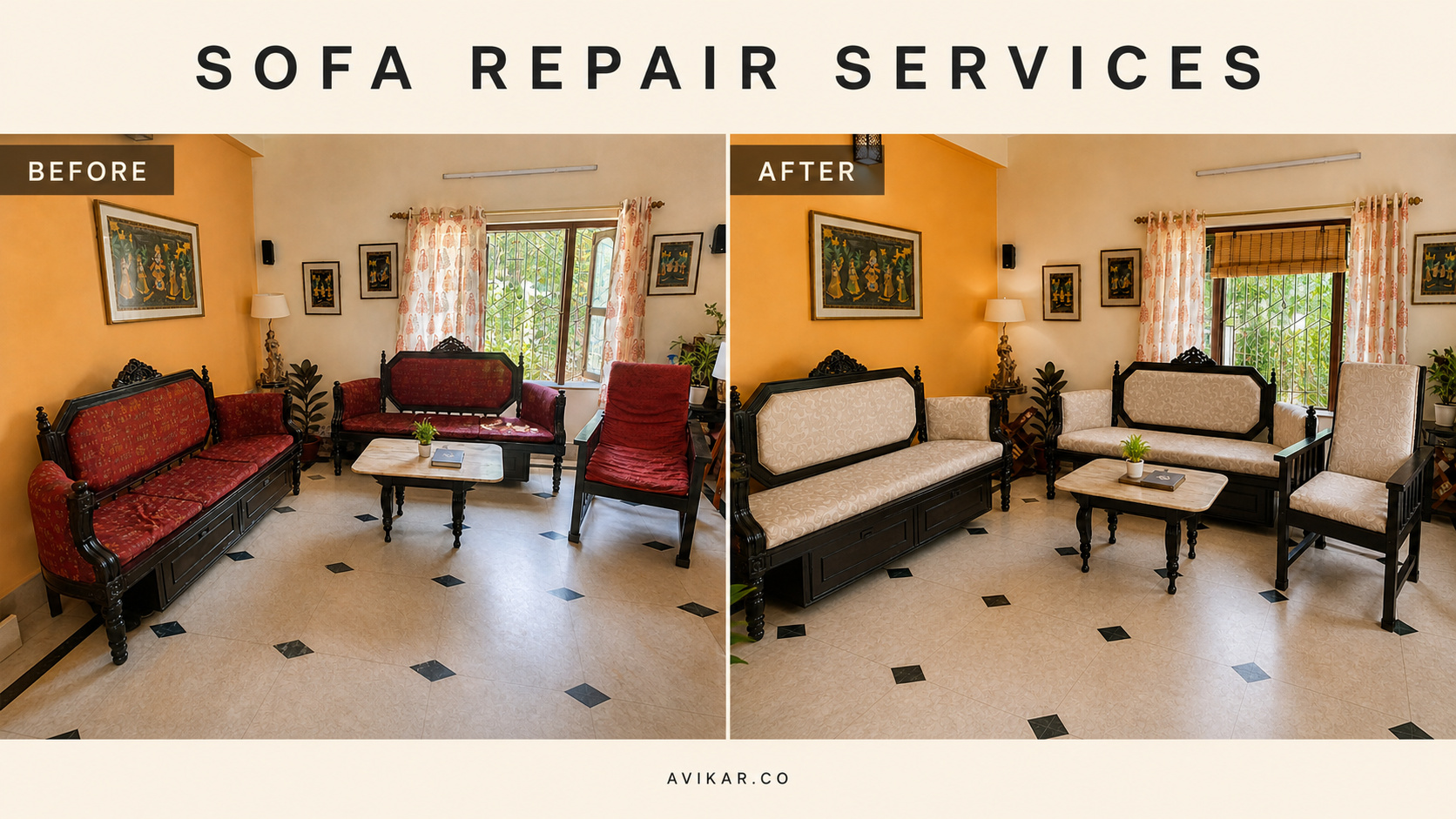
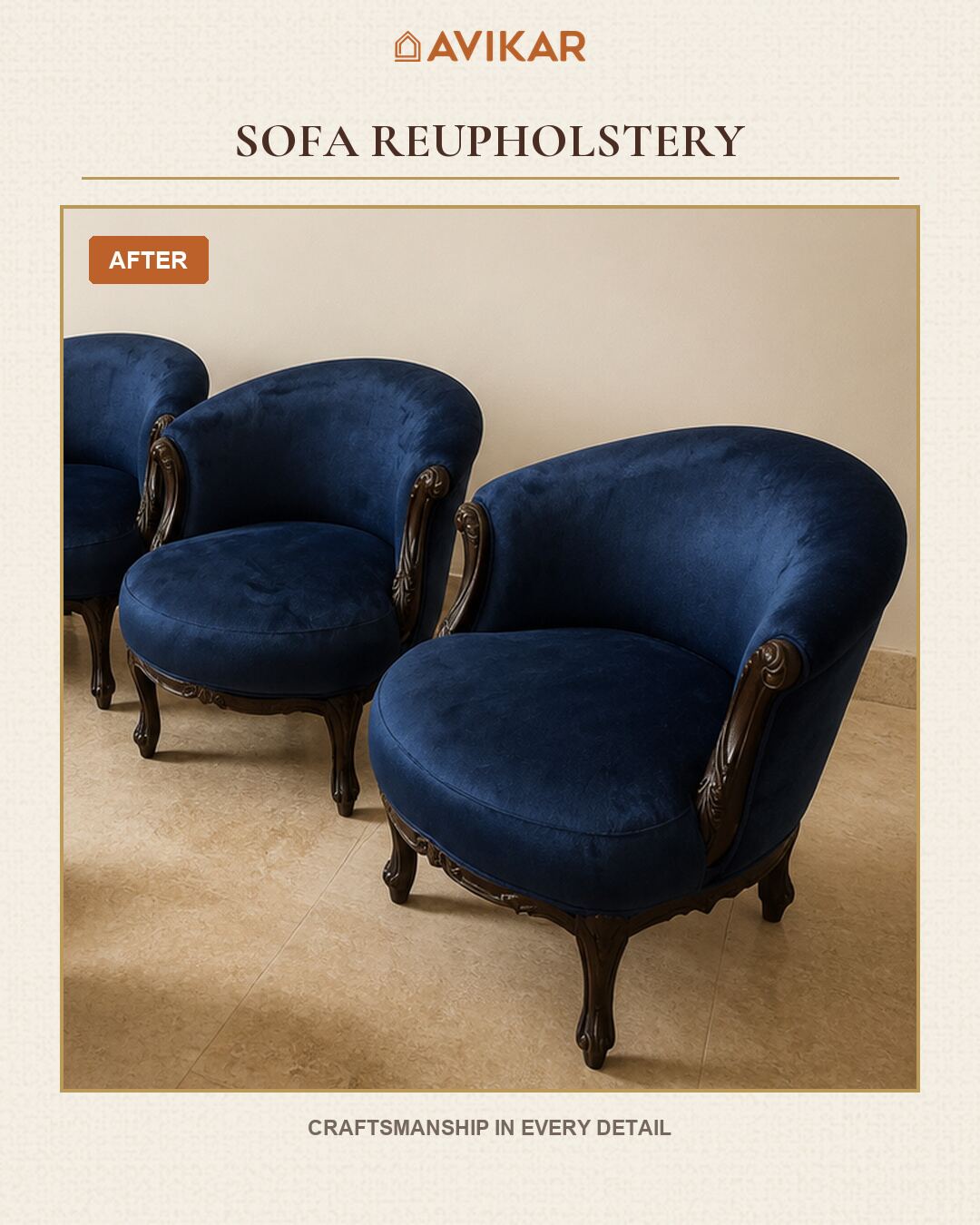
The carved teak, sheesham and rosewood sofa sets that came out of local workshops between the 1960s and the 1990s were built with jointed timber — mortise-and-tenon, dowelled, glued and pegged. Those frames are usually worth restoring even when the sofa looks beyond hope, for a simple reason: the seasoned timber in them is better than almost anything available at that price today, and the joinery can be knocked apart, re-glued and re-pinned. A loose joint on a frame like that is a repair. On these sets we rebuild everything above the frame and leave the carving alone.
The second group is the mass-produced sofa bought in the last ten or fifteen years, often built from plantation pine or a ply and particleboard box, assembled with staples and glue rather than joints. These can be repaired, but the economics are different. Once a stapled ply rail has split along the grain, or a particleboard corner block has crumbled where the staples went in, there is nothing left to fix the new work to. Screwing into a crumbled edge simply moves the failure two inches along.
The practical test: press a thumbnail into the frame timber where it is exposed under the sofa. Solid hardwood resists. If it dents like cork or you can flake material away at a staple hole, that corner is done.
Webbing and springs: the layer nobody quotes for
Most “sofa repair” in this city means restitching a cover and putting new foam in. That fixes the look for one season. If the elastic webbing has lost its tension or the jute webbing has stretched — and in our humidity jute stretches — the new foam is sitting on a hammock and will flatten on exactly the same schedule as the old one did.
Rusted springs are the other quiet failure. Serpentine and coil springs sit inside a sofa in still, humid air for nine months of the year. Sofas placed against an external wall, a wall that backs a bathroom, or on a ground floor in an older building rust from the inside out; you will not see it, but you will hear it, and eventually a clip lets go.
Any honest assessment should tell you the condition of this layer before it tells you about fabric. If a quotation goes straight from “sagging seat” to “new foam and new cover” without anyone lifting the deck, it is a cosmetic job being sold as a repair.
Foam: density decides how long the repair lasts
Thickness is what customers ask about. Density is what determines whether the seat is still level in three years. A thick, low-density foam compresses into a permanent hollow at the spot you always sit; a slightly thinner, higher-density foam holds its shape far longer. It is the same principle we apply when advising on mattresses, and it matters more on a sofa because the load is concentrated on two or three seats rather than spread across a bed.
The older Indian build — coir, rubberised coir and cotton batting — behaves differently again. Coir and cotton felt absorb moisture and, in a humid room, hold it. Polyurethane foam does not rot, but the cotton felt above it and the jute webbing below it will, which is why a musty sofa usually needs opening up rather than airing out. If your sofa smells and the smell strengthens when you press the seat, budget for the internal layers, not a deodoriser.
Fabric, leather and rexine: three different repair realities
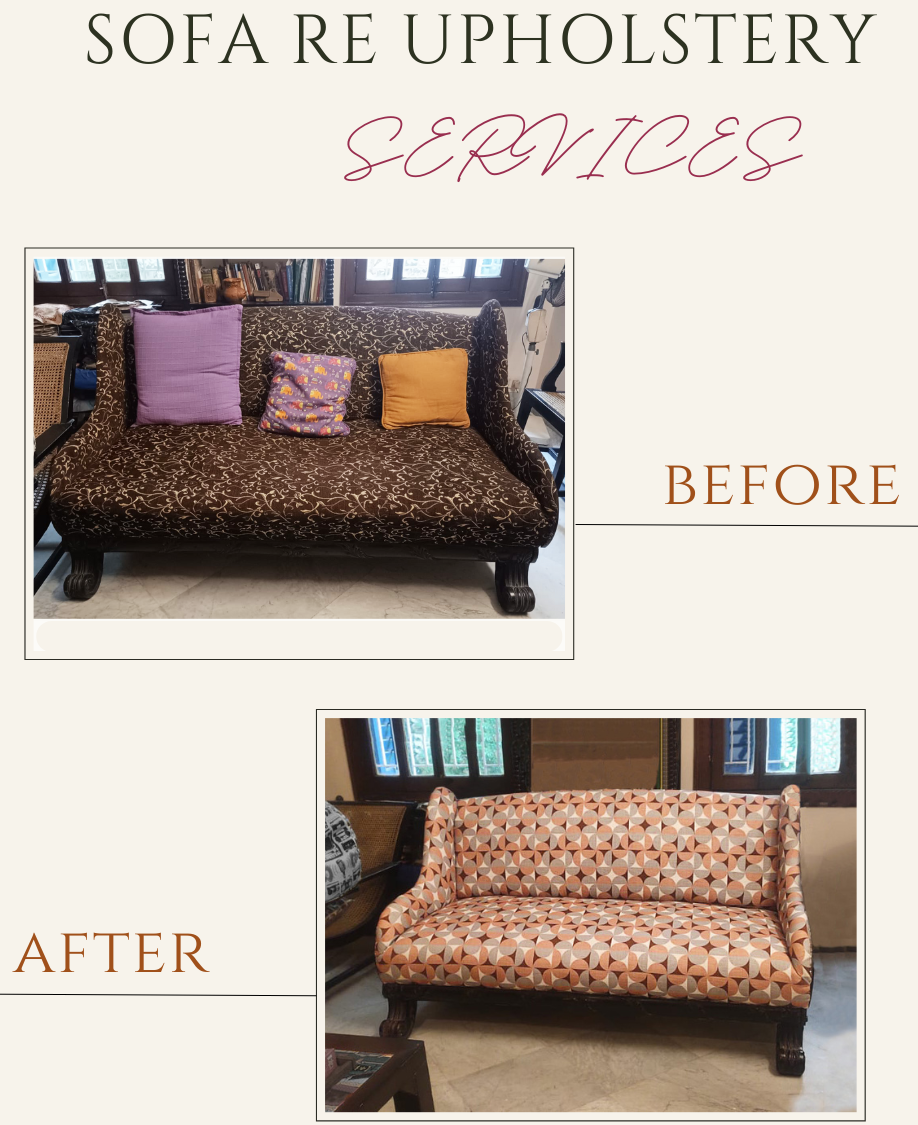
Woven upholstery fabric is the easy case. Tears, worn arms and faded panels are replaceable, and a fabric change is often the cheapest way to make a structurally sound sofa feel new. Our guide to choosing upholstery fabric covers durability, weave and how a fabric behaves in this climate.
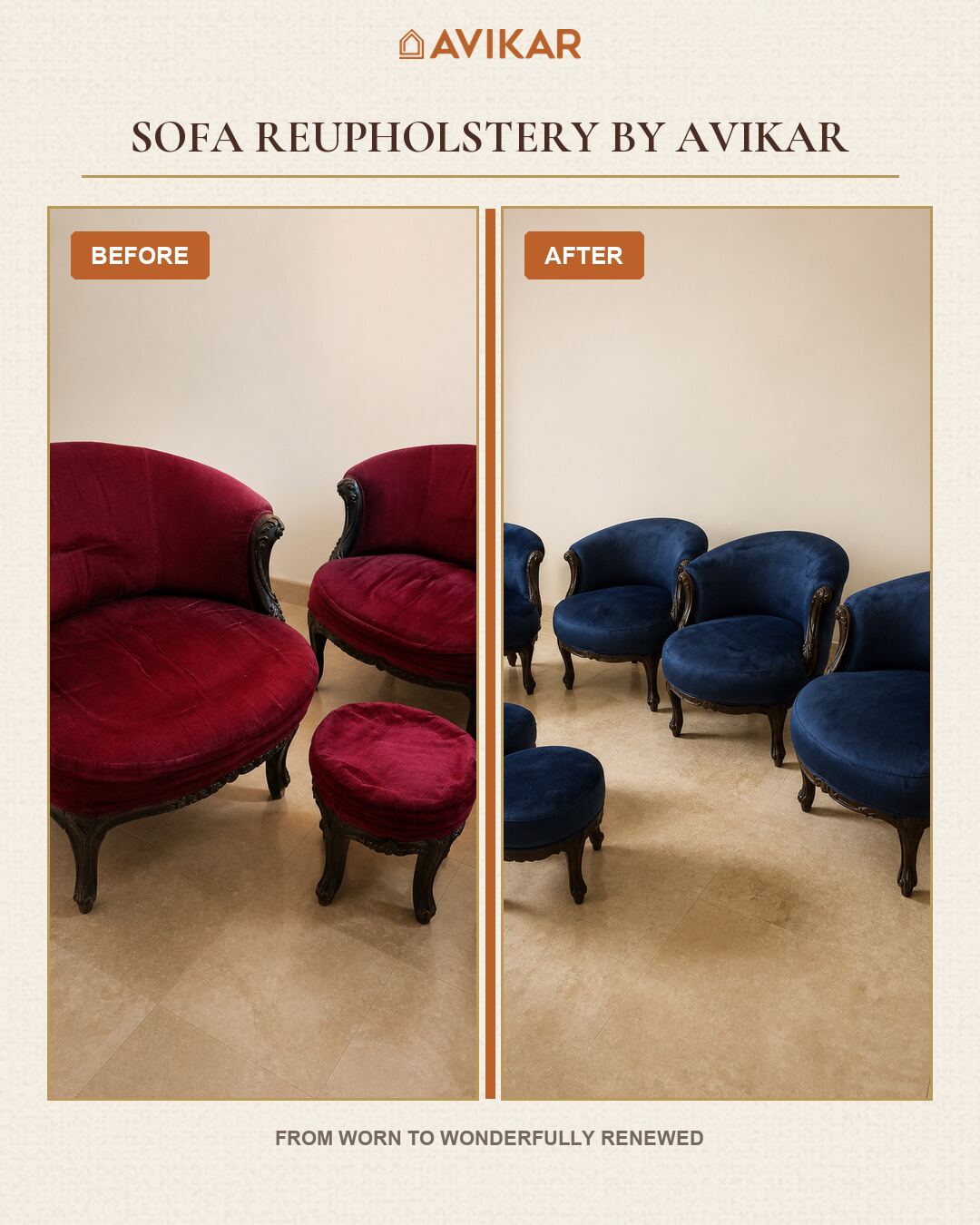
Genuine leather is repairable up to a point. Creasing, stretch and colour loss can be worked on; the seat panels can be replaced while the sides are retained if the hide has aged evenly. What cannot be undone is a crack that has gone through the finish into the substrate.
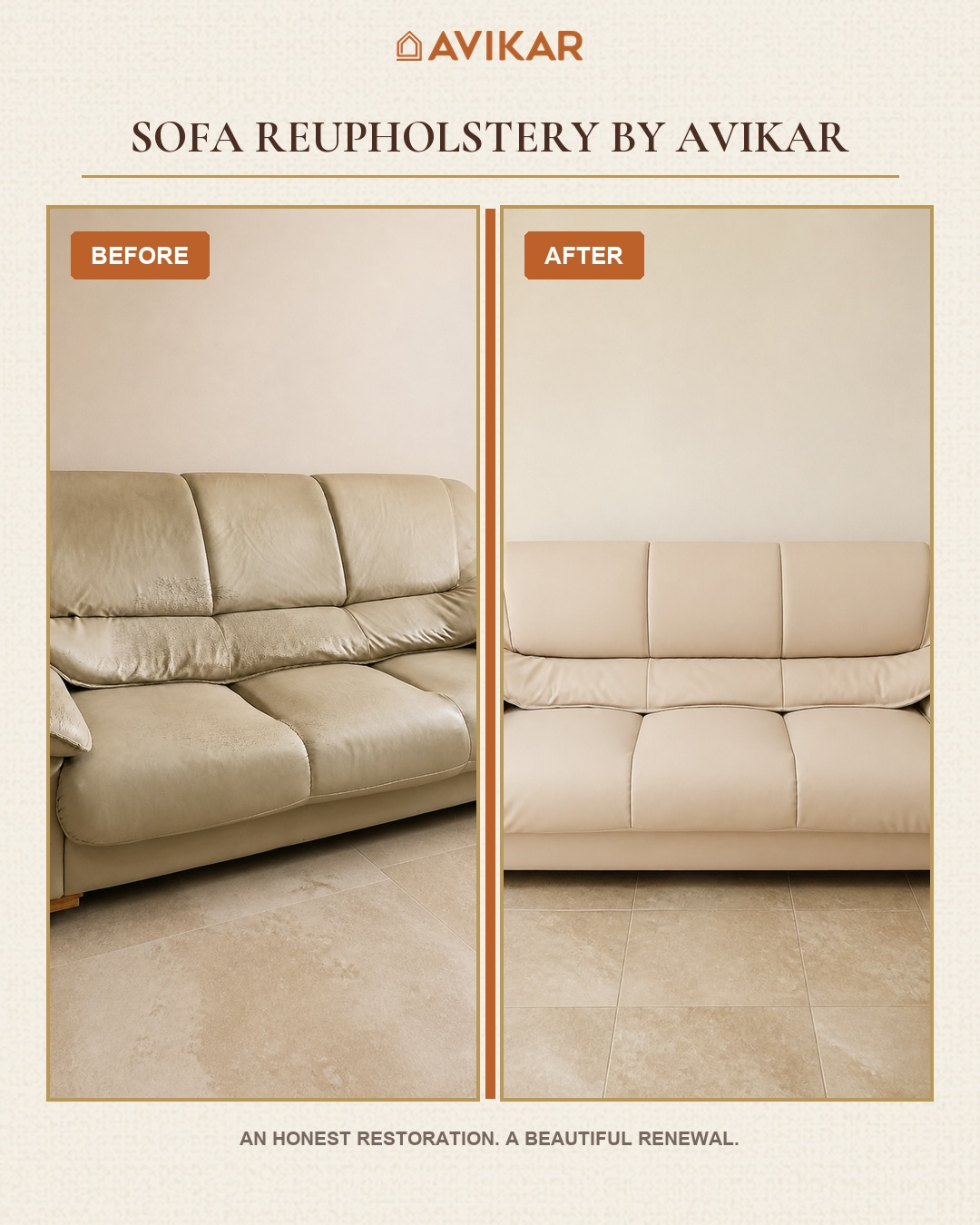
Rexine and PU “leatherette” is the honest exception. When the surface layer starts to peel, flake or come away in sheets — very common on budget sofas after four or five monsoons — it is delamination, not damage. There is no repair for it. The only route is stripping the material off and re-covering the sofa in something else. Anyone offering to patch peeling rexine is selling you a few months.
What can and cannot be repaired
| Problem | Repairable? | What actually happens |
|---|---|---|
| Loose or opened joints on a hardwood frame | Yes | Knocked apart, cleaned, re-glued and re-pinned |
| Stretched or snapped webbing | Yes | Full webbing replacement across the deck |
| Broken or rusted springs | Usually | Replaced; badly rusted units are swapped as a set |
| Flattened foam, uneven cushioning | Yes | New foam specified by density, not thickness |
| Torn, faded or dated fabric | Yes | Re-covered; a fabric change is the same job |
| Split main rail on a stapled ply frame | Rarely worth it | Nothing sound left to fix new work to |
| Crumbled particleboard corner blocks | No | Failure simply relocates to the next staple line |
| Peeling rexine or PU leatherette | No | Material is delaminating; must be replaced entirely |
| Active borer or termite in the frame | Not before treatment | Upholstery over an infested frame is money spent twice |
| Imported recliner mechanism, no spare parts | Often not | A mechanism problem, not an upholstery one |
Two Kolkata problems no national guide mentions
Borer and termite. Fine, flour-like powder collecting under a sofa leg or near a joint is powder-post beetle, and it is common in sheesham and mango-wood furniture here. It must be treated before any upholstery work begins. New fabric over an active infestation is the most expensive mistake in this category, because the frame keeps deteriorating underneath work you have already paid for.
The staircase and the lift. Serious structural work — reframing, full re-webbing, spring replacement — is workshop work, which means the sofa has to physically leave your home and come back. In older Central and North Kolkata buildings, a fixed three-seater frame will not go into a lift and sometimes will not turn on a landing. This needs to be settled before work is agreed, not on the morning of collection. Send photographs of the sofa and, if the building is old, of the staircase turn; it changes what is realistic. Lighter jobs such as foam replacement and cushion work can often be done at home.
Timing: think twice about peak monsoon
An opened-up sofa is a bare frame plus absorbent internal layers, and both take on ambient moisture. Structural work sits more comfortably outside the wettest weeks, and a restored sofa should not be pushed hard back against a damp external wall the day it returns. Leave a finger’s gap behind it — the same advice applies to upholstered headboards on external walls, for exactly the same reason.
How Avikar approaches a repair
We have been on Central Avenue since 1971 and have reupholstered over 1,000 pieces of furniture. The sequence is deliberately in this order:
- Share. Send photographs on WhatsApp — one full sofa shot, one close-up of the problem area, and approximate dimensions.
- Assess and select. We inspect where required and look at frame, webbing, springs and foam before discussing fabric, then help you choose foam, fabric and finishes.
- Approve and restore. You approve the quotation before any work starts. Our own team then repairs, upholsters and finishes the sofa.
Work is guided by the sofa rather than a fixed package, and we will say plainly when a frame is not worth restoring. If replacement is the better answer, our sofa buying guide and the sofa store are the next step; if the frame is sound and only the finish is tired, see sofa re-upholstery.
Frequently Asked Questions
Is it worth repairing an old sofa, or should I just buy a new one?
It depends almost entirely on the frame. If the frame is solid hardwood with real joinery — as most older Kolkata sofa sets are — repair is usually the better value, because you are keeping timber you could not buy at that price today. If the frame is stapled ply or particleboard and has split or crumbled, replacement generally makes more sense. A close-up photograph of the underside is often enough for us to tell you which situation you are in.
Why did my sofa sag again a few months after it was repaired?
Almost always because only the visible layers were replaced. New foam sitting on stretched webbing or a broken spring will flatten on the same schedule the old foam did. A durable repair replaces the support layer, not just the comfort layer.
Can sagging sofa cushions be fixed without redoing the whole sofa?
Yes, if the deck underneath is firm and level. Take the cushion off and press the platform — if it holds firm, new foam cut to the right density will solve it. If the platform dips, the cushion was never the problem.
Can peeling leatherette or rexine be repaired?
No. Peeling is the surface layer separating from its backing, and once it starts it continues across the whole panel. The sofa has to be re-covered in a different material. Any patch is temporary.
Does the sofa have to leave my home?
Not always. Foam replacement and cushion work can often be done at home. Frame repairs, full re-webbing and spring replacement are workshop jobs. If you live in an older building, send a photograph of the staircase turn along with the sofa photographs — access sometimes decides the approach.
How much does sofa repair cost in Kolkata?
It depends on which layers need work, the size of the sofa and the fabric chosen — a foam and cushion job and a full structural rebuild are very different pieces of work. We quote after seeing photographs or inspecting the sofa, and nothing begins until you approve that quotation. We do not publish a standard rate, because a package price on this kind of work usually means someone has decided what to replace before looking at it.
My sofa smells musty. Is that fixable?
Usually yes, but not by surface cleaning. The smell normally sits in cotton felt, coir or jute webbing that has held moisture, and it goes when those layers are replaced. If the smell gets stronger when you press the seat, it is internal.
Can I change the fabric completely rather than match the original?
Yes — a fabric change is the same job as a re-cover, and it is the most effective way to make a sound sofa suit a room that has moved on. We look at the sofa alongside the curtains and the rest of the room rather than in isolation.
Bring us your sofa
Send clear photographs on WhatsApp to 8080095551 — the full sofa, a close-up of the damage, and rough dimensions — and we will tell you honestly what can be restored and what cannot. Or visit the showroom and see fabrics and finishes in person before deciding anything.
Avikar Furniture & Furnishings
46 Central Avenue, Bowbazar, Kolkata 700012
Call or WhatsApp: 8080095551
Monday to Saturday, 10:30 AM to 7:00 PM. Sunday closed.
Sofa repair & restoration · Upholstery services · What sofas cost in Kolkata